



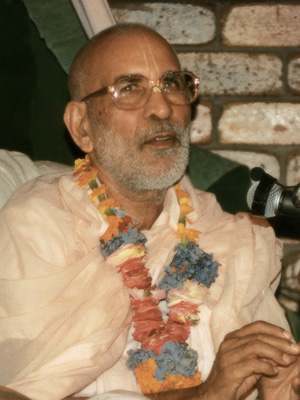
[This is a class given by Śrīla Bhaktivedānta Nārāyaṇa Gosvāmī Mahārāja in the evening of July 18, 1999, at Meye, Netherlands (Holland).
Note: This transcript has the following editors’ inputs: the language has been slightly edited at some places, endnotes have been added, and additional text has been included in square brackets to facilitate the flow and understandability of the content.
Topics of this class
- Meaning of Hera Pancami.
- How Mahaprabhu desires to hear the moods and melodies of Hera Pancami.
- Laksmi Devi, in anger, marches with her attendants toward Jagannatha’s servants and chariot.
- How Mahaprabhu visits Jagannatha, Baladeva, and Subhadra every day in Jagannatha Puri.
- How Mahaprabhu sees Jagannatha as Vrajendranandana Syamasundara of Vraja.
- Laksmi Devi searches for her husband in royal opulence.
- Laksmi imprisons associates like Sikhi Mahiti and Vakresvara Pandita.
- Mahaprabhu relishes the mood of Hera Pancami.
- Mahaprabhu asks Svarupa Damodara about Laksmi’s sulky mood.
- Description of different types of mana (sulky moods).
- Why Krsna did not bring the Vrajavasis to Dvaraka.
- Why Vraja pastimes not manifested in Dvaraka.
- Laksmi’s inability to enter Vrndavana is explained by Mahaprabhu and Svarupa Damodara.
- An outline of the essence of Rupa Gosvami’s teachings.
- Description of the goal of Mahaprabhu’s sampradaya.
- Instructions to follow Rupa and Raghunatha Dasa Gosvamis.
- Significance of Jagannatha taking Baladeva and Subhadra along with Him.
- Srivasa Pandita and Svarupa Damodara discuss Vraja over Dvaraka opulence.
- How a drop of Vrndavana is declared greater than all Vaikuntha and Dvaraka opulence
Śrīla Nārāyaṇa Gosvāmī Mahārāja: [Manglacarana]
Have they all come? Oh, you should come here. You should come here. Govinda Bhakata Prabhu should be here. Here, sit down. Today is Herā-pañcamī. In the first year, when Caitanya Mahāprabhu Ratha festival, Cart festival, He wanted to hear the melody [mellows] of Herā-pañcamī.
The meaning of Herā-pañcamī is that on the fifth day of the Cart festival, Lakṣmī becomes so worried: "Where has My husband gone?" He told Her, "Quickly I will return. I'm going to..." What?
Navin-kṛṣṇa dāsa (now Śrīpād Mādhava Mahārāja): For a change.
Śrīla Nārāyaṇa Gosvāmī Mahārāja: “For a change for some days.” And He went, and He never returned. And now it is the fifth day. She could not tolerate [it]. So She became very angry. Very, very angry.
And She ordered all Her associates, "You should take your weapons, [as if going to fight an] enemy." And She Herself became like the commander-in-chief. And She attacked Her husband's party. Where had He gone? She wanted to attack.
Caitanya Mahāprabhu is with His associates. In the very morning, He went to Sundarācala, Guṇḍicā Mandira,and He took darśana of Jagannātha, Baladeva, and Subhadrā with His associates.
Whenever He used to go to Jagannātha—whether in the Jagannātha Temple or anywhere—He used to see Kṛṣṇa, Jagannātha as Vrajendra-nandana Śyāmasundara: a peacock feather on His head, a flute in His hands, and very beautiful kamala-nayana. Kamala-nayana means?
Devotee: Lotus-like flower. Lotus-like.
Śrīla Nārāyaṇa Gosvāmī Mahārāja: And with all these symptoms, He used to see [Jagannātha as Kṛṣṇa] in Vraja, in Vṛndāvana, with the gopīs. He never saw that Baladeva was there, Subhadrā was there, and Sudarśana was there, because in Vṛndāvana no Sudarśana is needed. Never. He is never used there.
And He (Mahāprabhu) never prayed to Baladeva or Subhadrā in the temple. Only during the Cart festival, when He used to see Baladeva and Subhadrā, then He would do so. Otherwise, [He offered His prayers] only to Jagannātha-deva.
This thing is very wonderful.
The day before, Kāśī Miśra, the guru of Mahārāja Pratāparudra, spoke to Pratāparudra and advised him, "Bring all the gold, golden and jeweled ornaments, and you should give them to Lakṣmī-devī. So many opulent jewels. You should decorate Lakṣmī-devī and make Her so beautiful. Also, this Herā-pañcamī [festival] should be arranged in such a way that everyone will be astonished. They have never seen [anything] like this before, because Caitanya Mahāprabhu wants to see and taste all these mellows."
And there, in the evening, Lakṣmī-devī, with all [Her] associates, was decorated with so many golden jewels and ornaments, very beautiful precious clothes and garments. They were decorated with so much opulence.
And then, at the gate of the Guṇḍicā Temple, Kāśī Miśra gave a very beautiful seat to Mahāprabhu and His associates. Śrīvāsa Paṇḍita, Svarūpa Dāmodara, Rāya Rāmānanda, and all were there.
And then, very quickly, Lakṣmī came there with all Her associates in [an] opulent manner, as if she were going to attack Jagannātha. First, She attacked them [the servants of Jagannātha], and She imprisoned them all. She had all the associates of Mahāprabhu—Śikhi Māhiti, Vakreśvara Paṇḍita, and all the other associates of Mahāprabhu [who were playing the part of Jagannātha’s servants]—bound like prisoners. And they began to beat [them] with whips made of cloths. They were punishing [them] all.
"Oh, you should pay, because you are guilty. You have taken My husband, and where have you kept [Him]? You should bring Him at once, otherwise I will..."
Navin-kṛṣṇa dāsa: Punish you
Śrīla Nārāyaṇa Gosvāmī Mahārāja: “Punish you and take what? Donation?
Devotee: Fines.
Śrīla Nārāyaṇa Gosvāmī Mahārāja: “Fines. Like fines.” And thus they imprisoned whole associates of Mahāprabhu. And seeing this, Caitanya Mahāprabhu was very happy, so happy, and He was tasting the mellow of all these things.
Mahāprabhu said to Svarūpa Dāmodara , "I have heard that Satyabhāmā used to have some māna, and she would give up all her ornaments and remain in a separate room, a dark room, and..." [mayle vasant]
Navin-kṛṣṇa dāsa: Dirty, dirty cloth.
Śrīla Nārāyaṇa Gosvāmī Mahārāja: “Dirty clothes She used to take, taking off all golden ornaments and weeping and by these nails doing like”…
Navin-Kṛṣṇa dāsa: Scratching.
Śrīla Nārāyaṇa Gosvāmī Mahārāja: "And weeping and weeping. But this—this Lakṣmī—I see another kind of māna. It seems that She has invaded with so many..."
Navin-kṛṣṇa dāsa: Army-soldiers.
Śrīla Nārāyaṇa Gosvāmī Mahārāja: "Army soldiers, being like a commander-in-chief, and She is going to attack anyone. I have never seen anything like this, nor have I ever heard [of it] in any books. Lakṣmī is doing [this]."
Then Svarūpa Dāmodara replied, "There are so many kinds of māna, but there is so much difference between Vṛndāvana and where?
Devotee: Dvārakā-dhāma.
Śrīla Nārāyaṇa Gosvāmī Mahārāja: "Dvārakā. There is such a great difference."
Mahāprabhu was speaking. He was asking Svarūpa Dāmodara:
yadyapi jagannātha karena dvārakāya vihāra
sahaja prakaṭa kare parama udāra
tathāpi vatsara-madhye haya eka-bāra
vṛndāvana dekhite tāṅra utkaṇṭhā apāra
(Śrī Caitanya-caritāmṛta, Madhya-līlā 14.117–18)
[Although Lord Jagannātha enjoys His pastimes in Dvārakā-dhāma and naturally manifests sublime liberality there, still, once a year He becomes unlimitedly eager to see Vṛndāvana.]
Prema-prayojana dāsa: [Reading from Caitanya-caritāmṛta] Although, Lord Jagannātha enjoys His pastimes at Dvārakā- Dhāma and naturally manifests sublime liberality there, still once a year He becomes unlimitedly eager to see Vṛndāvana.
Srila Nārāyaṇa Gosvāmī Mahārāja: "Why? Knowingly because He has left Vṛndāvana. Why? To please the gopīs, to pacify the gopīs. It is said that He left Vṛndāvana and came to Mathurā and Dvārakā because He cannot neglect any of His devotees—whether in Vṛndāvana, Mathurā, Dvārakā, or anywhere else. He must support them and nourish them.
Also, if Jarāsandha were to attack, there was no fort in Vṛndāvana, and Vṛndāvana would be ruined. Therefore, Kṛṣṇa did not go there. Do you understand?
If Kṛṣṇa were to go there and Jarāsandha came to know that He was not actually the son of Vasudeva and Devakī, but the son of..."
Navin-kṛṣṇa dāsa: "Nanda and Yaśodā."
Śrīla Nārāyaṇa Gosvāmī Mahārāja: "Then he will attack. Where? Vṛndāvana.
And Nanda Bābā is a cowherd, a gopa. He is not a warrior or a soldier, and in Vṛndāvana there are no soldiers like that. So Jarāsandha would ruin all of Vṛndāvana, and he might imprison Yaśodā and Nanda Bābā, just as Vasudeva and Devakī were imprisoned. Thus Vṛndāvana would be devastated.
This is one reason, but it is an external reason.
Also, Kṛṣṇa has said—or one may say—that He could go there sometimes and quickly return. Sometimes He may go. What harm is there? Oh, there are so many harms. They know that so many of His friends are there, and therefore they would be attacked and destroyed. So Kṛṣṇa does not go there for that reason also. But it may be asked: if He could take the whole of Mathurā-purī with all His associates and, in one night, transfer them all to Dvārakā-purī, then He could also make so many..."
Navin-kṛṣṇa dāsa: Royal palaces.
Śrīla Nārāyaṇa Gosvāmī Mahārāja: "Royal palaces there for each and every one—not only for Himself, but for all His associates. For Akrūra, Uddhava, Vasudeva, Devakī, all His friends, and their friends also. So many thousands and millions of Mathurāvāsīs.
In one night, they saw that they had gone from Mathurā to Dvārakā. They had fallen asleep in Mathurā, but during the night they found themselves in Dvārakā. They were sleeping there in Mathurā, but in the night they saw that they were in..."
Devotee: Dvārakā.
Śrīla Nārāyaṇa Gosvāmī Mahārāja: "In the morning, when they woke up, it was very wonderful. So Kṛṣṇa can do anything He likes. He can take all His associates from Vṛndāvana—Rādhikā, Lalitā, Viśākhā, all the sakhīs, all His friends, Śrīdāmā, Stoka-kṛṣṇa, Lavaṅga. He can take His mother and father, Nanda Bābā and Yaśodā, and all the Vrajavāsīs there.
What harm would there be? Any harm? If Kṛṣṇa does this, what harm is there? Can you tell? What? In the night He can take all the Vrajavāsīs there. Any harm? No harm, I think. Any harm? If all the Mathurāvāsīs can be there, they can also be there. What harm is there? No harm."
Devotee: Rasa-vicāra.
Śrīla Nārāyaṇa Gosvāmī Mahārāja: What rasa-vicāra? What rasa-vicāra? Can you tell me something?
Govinda Bhakata dāsa (Now Śrīpād Aśrama Mahārāja): The Vrajavāsīs, if they go to, if they go to Dvārakā, then how [will] the gopis meet with Kṛṣṇa at night.
Śrīla Nārāyaṇa Gosvāmī Mahārāja: They can meet always. What harm [is there] if they are meeting? Any harm?
Govinda Bhakata dāsa: Yes. So much harm. Because Kṛṣṇa is there with his queens. In Dvārakā, He is there with his queens.
Śrīla Nārāyaṇa Gosvāmī Mahārāja: Oh, queens are queens, and their sakhīs are sakhīs. What harm [is there]?
Govinda Bhakata dāsa: So much harm.
Jayantakṛt dāsa (Now Śrīpād Śuddhādvaitī Mahārāja): In Dvārakā, all the queens are so much decorated with jewels, and all the gopis are simple village girls. They will feel so much out of place.
Devotee 2: How will Govardhana and Sevā-kuñja go there?
Śrīla Nārāyaṇa Gosvāmī Mahārāja: How will Vṛndāvana go there? Will Govardhana also go there?"
Devotee: They can do anything.
Lady Devotee: Gokul is also Vraja vana.
Śrīla Nārāyaṇa Gosvāmī Mahārāja: "This is very confidential. Then there would be a quarrel between mādhurya-bhāva and opulence (aiśvarya). What would Kṛṣṇa say? That He is the son of Vasudeva and Devakī, or the son of Nanda and Yaśodā? What would He say?
It would be very difficult for Kṛṣṇa.
Navin-kṛṣṇa dāsa: Contradiction of mellows.
Śrīla Nārāyaṇa Gosvāmī Mahārāja: "Contradiction. [Will] He take His flute? Will He take a feathercrock [peacock feather] there? And will He go with His friends for cowherding in Dvārakā? Will He go? Can He tell them, 'I am the son of Nanda Bābā and Yaśodā'? Can He tell this?"
Navīna-kṛṣṇa dāsa: "In Dvārakā, everyone respects Kṛṣṇa."
Śrīla Nārāyaṇa Gosvāmī Mahārāja: So opulence and mādhurya, they cannot live together. They cannot. By their constitutional nature. If you will realize all these things, be madhyama- adhikārī even really, then you can be one-pointed to Vrajendra-nandana, otherwise not. Understand what I told? If you will be in madhyama-adhikārī really, and you will hear all these things in good association, and you will realize what is opulence and what is..
Navin-kṛṣṇa dāsa: Sweetness.
Śrīla Nārāyaṇa Gosvāmī Mahārāja: The mādhurya-bhāva of Vṛndāvana. Vṛndāvana cannot come to Dvārakā, and Dvārakā cannot go there. Never. They are quite opposite.
And this is called Rasābhāsa?" Not
Devotee: Rasa.
Śrīla Nārāyaṇa Gosvāmī Mahārāja: Rasadūṣṭā. What is Rasadūṣṭā?
Devotee: Overlapping of mellows.
Śrīla Nārāyaṇa Gosvāmī Mahārāja: "Yes. So first you should know what these things are. You should know what is opulence and what is the rasa-vicāra of mādhurya.
In Dvārakā, there is always opulence. Everyone knows that Kṛṣṇa is the Supreme Personality of Godhead. Sometimes He manifests four arms, and He can do anything. He can even bring a dead person back to life, as He has done. Opulence means to think that Kṛṣṇa is the Supreme Personality of Godhead; no death and no birth.
But in Vṛndāvana, what is there? Always mādhurya-bhāva. He has taken birth from the womb of Mother Yaśodā. He is quite ignorant.. He cannot even turn over without the help of His mother. He is always hungry. Sometimes He becomes angry. Hungry and angry—both. If He is hungry, He may steal butter here and there.
And He can tell lies: 'Mother, when did I take it? When did I steal it? I never stole anything.'
'Oh, in the early morning you send Me for cowherding. I go with My friends the whole day, running here and there with the cows. In the evening, at night, I return from cowherding. Then I become so tired. I take something and sleep. When did I take this butter? I have never done it.'
And He begins to weep.
Then Mother Yaśodā says, 'Oh, You have certainly taken it. You have stolen the butter.'
Kṛṣṇa then says, weeping, 'Mother, perhaps I am not your son. That is why you are accusing Me of stealing butter. Therefore, I should go away somewhere else.'
Then Yaśodā-mā begins to weep, and her heart melts. She takes Kṛṣṇa on her lap and says, 'Oh, never say this. You have never stolen anything. I know. Never.'
But Kṛṣṇa says, 'I have done it, Mother. I have done it.'
And then both of them begin to weep. So this is the mādhurya mood.
She was tying Kṛṣṇa to the mortar, you know. If she knew that Kṛṣṇa is the Supreme Personality of Godhead, how could she beat Him?
But one thing you should mark and understand: whether there is opulence or no opulence, there is no harm. There may be opulence. But the pastimes of Kṛṣṇa are like those of an ordinary human being (nara-vata)."
Devotee: Human life.
Śrīla Nārāyaṇa Gosvāmī Mahārāja: Like a human boy. Always like that. His pastimes should not cross this mood. Like Pūtanā came and took Kṛṣṇa, saying, 'My boy, my dear boy, my dear boy,' and she took Him, intending to give Him poison. Kṛṣṇa closed His eyes as if He was afraid to see her. And He did nothing. He simply sucked the milk. But if she dies, what can He do? He never showed any great form or anything. He acted only like a child, like a boy of just six days old. Yet she was killed.
So this is like...? What?
Devotee: Human-like.
Śrīla Nārāyaṇa Gosvāmī Mahārāja: Human-life. This was a very high class of opulence. A demon like Pūtanā...Once when Kaṁsa was conquering whole world and he went to Pūtanā, and there was a very big war.
Navin-Kṛṣṇa dāsa: Fighting.
Śrīla Nārāyaṇa Gosvāmī Mahārāja: Fighting. She was going to defeat Kaṁsa, but Kaṁsa was very political and knew politics. He told her, 'Now I am accepting you as my sister. You are my sister, and you can help me, and I will help you.' This is called sandhi. Sandhi means?
Devotees: Alliance. Compromise.
Śrīla Nārāyaṇa Gosvāmī Mahārāja: Compromise. And then he quickly made this arrangement. So she was very, very strong and powerful. To kill a demon like Pūtanā was very, very difficult. Even Kaṁsa could not defeat her. This is opulence. Kṛṣṇa lifted Girirāja Govardhana. It was not an easy task.
[To the devotees] Please do not close your eyes.
Navin-Kṛṣṇa dāsa: Open your eyes.
Śrīla Nārāyaṇa Gosvāmī Mahārāja: "Open your eyes and be seated like this.
So, what was I telling? Kṛṣṇa lifted Govardhana, and He held Govardhana for seven days..."
Navin-kṛṣṇa dāsa: Lift up Govardhan is not an easy task.
Śrīla Nārāyaṇa Gosvāmī Mahārāja: Oh, like an elephant has taken a lotus flower on its trunk. But if it is hard, an ordinary man cannot do it. Yet Kṛṣṇa—how was He? He was smiling, sometimes taking His flute, and standing in a dancing mood with His threefold bending form. All the cowherd boys took their sticks and said, 'Oh, Govardhana should not come down now [to Govardhana] .
So everyone was thinking that the boys were actually holding up the mountain. Nanda Mahārāja was a very elevated devotee of Nārāyaṇa. He prayed, 'Oh Nārāyaṇa, this mountain should not fall down.' And what about the gopīs? The power of Kṛṣṇa Himself is Rādhikā. She simply did like this [glancing expression], and He held it."
Navin-kṛṣṇa dāsa: Sidelong glance.
Śrīla Nārāyaṇa Gosvāmī Mahārāja: Whole Govardhana. 'If you come down, you will be finished at once. You will be burned to ashes. You should remain within My vision.' Kṛṣṇa was not doing anything. He had already done everything, and He was simply acting in that way.
So, this was a very great display of opulence. But He never manifested a huge form, a four-handed form, or anything like that. Therefore, whether there is opulence or no opulence, He appears like a human being, it is called mādhurya. That is why Kṛṣṇa is the friend of all the gopas. He is beloved by all the gopīs, and He is the son of all the elder gopīs.
In Dvārakā this cannot be. It is absurb. There is only opulence. Sometimes Kṛṣṇa may manifest a four-handed form or a big form. So the mood of Vṛndāvana cannot go there. He is bound to say there, 'I am the son of Vasudeva and Devakī. I am a kṣatriya. '
But in Vṛndāvana, what is He? 'I am a gopa.'
How will Kṛṣṇa reconcile this if all the gopas and gopīs come to Dvārakā? This is against rasa-vicāra. Therefore, Vṛndāvana will never come there. And He cannot take His flute, peacock feather, His threefold-bending form, and His beauty like manmatha-manmathaḥ. He cannot perform those pastimes there. If He performs rasa with the gopīs on the bank of the ocean while in Dvārakā, what will all His queens think?
Navin-kṛṣṇa dāsa: They laugh.
Śrīla Nārāyaṇa Gosvāmī Mahārāja: So it cannot be there. Therefore, Vṛndāvana and the gopīs will never come there. Kṛṣṇa may come in His other form, and that form is called a manifestation, Vāsudeva. But Kṛṣṇa cannot give up Vṛndāvana—Vrajendra-nandana Śyāmasundara. He cannot.
Even for a moment, He never leaves Vṛndāvana.
Vṛndāvanaṁ parityajya padam ekaṁ na gacchati: [Kṛṣṇa never goes even a step outside Vṛndāvana.]
So here, Vṛndāvana and all the gopīs cannot come there. That was His question.
He is saying:
yadyapi jagannātha karena dvārakāya vihāra...
Jagannātha, being in Mathurā-purī, which is like Dvārakā. He is with His queens—Vimalā-devī, like Satyabhāmā, Rukmiṇī, and all others. He is also with Baladeva and Subhadrā.
sahaja prakaṭa kare parama udāra...
But although He resides in Dvārakā throughout the year, once a year He desires to go to Vṛndāvana, and He goes very trickily. This has been described in the Purāṇas, and Śrī Jīva Gosvāmī and Śrīla Rūpa Gosvāmī have quoted this.
In His last days, Kṛṣṇa came from Dvārakā and defeated and killed Dantavakra. Then He went to Gokula and met all the Vrajavāsīs. He embraced them all and wept bitterly.
Then He played with all the gopīs and gopas. After some days, He took all His associates of Vṛndāvana—Nanda Bābā, Yaśodā, all the mothers, all the sakhīs, all the sakhās, and even His Vṛndāvana-bhūmi—with Him and went to Goloka Vṛndāvana there, aprakaṭa Vṛndāvana. And His one form, like Vāsudeva Kṛṣṇa returned to Dvārakā.
These are very secret things.
So, when did He come [to Kurukṣetra]? Once a year. When? At the time of the solar eclipse.
I will describe these things tomorrow. I am coming to my point now. Here...
vṛndāvana-sama ei upavana-gaṇa
tāhā dekhibāre utkaṇṭhita haya māna
(Śrī Caitanya-caritāmṛta, Madhya-līlā 14.119)
What [is the] meaning?
Prema-prayojana dāsa: [Reading from Caitanya-caritāmṛta] Pointing out the neighboring gardens, Sri Caitanya Mahāprabhu said, "All these gardens exactly resemble Vṛndāvana. Therefore, Lord Jagannātha is very eager to see them again.
Śrīla Nārāyaṇa Gosvāmī Mahārāja:
bāhira ha-ite kare ratha-yātrā-chala
sundarācale yāya prabhu chāḍi’ nīlācala
(Śrī Caitanya-caritāmṛta, Madhya-līlā 14.120)
Prema-prayojana dāsa: Externally, he gives the excuse that he wants to participate in the Ratha-yātrā festival, but actually he wants to leave Jagannātha Purī to go to Sundarācala, Guṇḍicā temple, the replica of Vṛndāvana.
Śrīla Nārāyaṇa Gosvāmī Mahārāja:
ānā-puṣpodyāne tathā khele rātri-dine
lakṣmī-devīre saṅge nāhi laya ki kāraṇe?
(Śrī Caitanya-caritāmṛta, Madhya-līlā 14.121)
Prema-prayojana dāsa: The Lord enjoys his pastimes day and night in various flower gardens. But why did He not take Lakṣmī Devī, the goddess of fortune, with Him?
Śrīla Nārāyaṇa Gosvāmī Mahārāja: What is the question? What is the question? Mahāprabhu is asking.
Devotee: He is asking: 'Why, when He goes to Vṛndāvana, does He not take Lakṣmī-devī with Him?'"
Śrīla Nārāyaṇa Gosvāmī Mahārāja: What, what is the question?
Devotee: Why didn't He take Lakṣmī Devī with Him to Vṛndāvana?
Śrīla Nārāyaṇa Gosvāmī Mahārāja: Why? What is the reason? Mahāprabhu is asking: 'If He is going to play there (to enjoy pastimes), why does He not take Lakṣmī-devī with Him? If Kṛṣṇa is going to Vṛndāvana, He could take all [of] His queens. What harm would there be?'
Devotee: Rasadūṣṭā.
Śrīla Nārāyaṇa Gosvāmī Mahārāja: Rasa-dūṣṭā. He cannot take Lakṣmī-devī there. Mahāprabhu is asking, and Svarūpa Dāmodara is answering. You should try to understand all these things. Then you will gradually come to at least madhyama-adhikāra. Only worshiping the Deity and always absorbed only in that and not hearing high classes of hari-kathā, only worshiping and worshiping - you cannot understand all these things.
Especially in Kali-yuga, harināma is superior:
harer nāma harer nāma harer nāmaiva kevalam
kalau nāsty eva nāsty eva nāsty eva gatir anyathā.
Bṛhad-Nāradīya Purāṇa
[In this age of quarrel and hypocrisy the only means of deliverance is chanting the holy name of the Lord. There is no other way, there is no other way, there is no other way.*]
Someone may steal away your Deities, and then there may be great difficulty. If you have no money, you cannot purchase the paraphernalia for worship. But in chanting harināma, nothing is required. A day will come when everyone will chant and come to this process. It is very near to Dvāpara-yuga; we are doing some [Deity worship]. Especially for gṛhastha-bhaktas, Deity worship is essential. But I want that you should not remain always in kaniṣṭha-adhikāra. Never. Bhakti is like a current; you should gradually develop. Even while worshiping, you should progress. You know that Mahāprabhu was worshiping Girirāja. A devotee sent from Vṛndāvana brought Guñjā-mālā and Govardhana-śilā. How did He worship?
He bathed Śrī Ṭhākurajī with His own tears. Sometimes He kept the śilā here, sometimes here, sometimes on His eyes. In this way He worshiped.After six years, He gave the Govardhana-śilā to Raghunātha and instructed him to worship. He gave only one earthen pot of water and eight mañjarīs with two very soft leaves...
Devotees: Leaves ... leaves.
Śrīla Nārāyaṇa Gosvāmī Mahārāja: And not mature tulasī leaves—very soft tulasī with tender leaves. This was such loving service. By what mood? By thinking of the Guñjā-mālā as Rādhikā, and Girirāja Himself as Nandanandana, Vrajanandana Śyāmasundara, and serving in that mood. So we should try to realize all these things by becoming a madhyama-adhikārī. A kaniṣṭha-adhikārī cannot understand these things.
Therefore, try to come to madhyama-adhikāra through high-class association. Only this can help. Simply reading books will not help. Never. Because the lock and key are in the hands of high-class devotees.
yāha bhāgavata paḍa vaiṣṇavera sthāne
ekānta āśraya kara caitanya-caraṇe
(Śrī Caitanya-caritāmṛta, Antya-līlā 5.131)
[If you want to understand Śrīmad-Bhāgavatam, you must approach a self-realized Vaiṣṇava and hear from him. You can do this when you have completely taken shelter of the lotus feet of Śrī Caitanya Mahāprabhu.']
They can unlock the treasure, and then you can realize all these things. So, you know, what was Caitanya Mahāprabhu's question? Again, you should repeat the question.
Devotee: If Lord Jagannātha is going to Sundarācala, why is He not taking Lakṣmī-devī with Him?
Śrīla Nārāyaṇa Gosvāmī Mahārāja: Now, what harm is there?
Then Svarūpa Dāmodara replied: 'Śuna, Prabhu, kāraṇa ihāra.'
'Oh Prabhu, please hear the reason behind this.'
'Vṛndāvana-krīḍāte Lakṣmīra nāhi adhikāra.'
What does this mean?
svarūpa kahe – śuna, prabhu, kāraṇa ihāra
vṛndāvana-krīḍāte lakṣmīra nāhi adhikāra
Śrī Caitanya-caritāmṛta (Madhya-līlā 14.122)
Prema-prayojana dāsa: Svarūpa Dāmodara replied: 'My dear Lord, please hear the reason for this. Lakṣmī-devī, the goddess of fortune, cannot be admitted into the pastimes of Vṛndāvana.'
She is not qualified [for those pastimes].
Śrīla Nārāyaṇa Gosvāmī Mahārāja: She is not qualified. All the queens there—Satyabhāmā, Rukmiṇī, and all the others—cannot enter Vṛndāvana in that mood. There are eight principal queens, others were sixteen thousand and one hundred and these eight were special but but none of them are qualified.
[To enter Vṛndāvana] they would have to take birth from the womb of gopīs. They would have to be married to gopas and they will be like parakīya, like all the gopīs; they will give up their husbands and everything [for Kṛṣṇa] and be under the guidance of the gopīs. Then they can serve Kṛṣṇa; then they can be in Vṛndāvana. Otherwise, it is not possible.
We know that even Lakṣmī-devī performed severe austerities in Baelvana, desiring to enter Vṛndāvana. But she could not cross the Yamunā and could not witness the rasa dance. She desired to see the rāsa-līlā, but she was unable to do so.
Yogamāyā is more than Lakṣmī and can control all. Yogamāyā told Her: 'You are a chaste lady, a brāhmaṇī, and you are married to Nārāyaṇa. Can you give up your husband and marry a gopa?'
Lakṣmī-devī replied: 'How can I do this? I cannot.'
Then Yogamāyā said: 'Then you cannot enter Vṛndāvana. You are not qualified.' Can you make cow dung?
Devotee: Patties, cow dung patties.
Śrīla Nārāyaṇa Gosvāmī Mahārāja: [Lakṣmī-devī] “Oh I cannot. I don't know.”
Navin-Kṛṣṇa dāsa: So that's how is that?
Śrīla Nārāyaṇa Gosvāmī Mahārāja: “Can you milk cows? Never? Then you cannot enter. First, you must take birth from the womb of a gopī. Then be with the gopīs, try to follow the gopīs, and you will have to marry a gopa, like Durmukha, Durmada, Abhimanyu, Govardhana Malla, and others. Then, giving up everything, you can go to Kṛṣṇa and make Kṛṣṇa your beloved. This is the only process. Otherwise, there is no other process [to attain the association of Kṛṣṇa in Vṛndāvana. ”
Therefore, Lakṣmī-devī is not qualified for these pastimes.
vṛndāvana-līlāya kṛṣṇera sahāya gopī-gaṇa
gopī-gaṇa vinā kṛṣṇera harite nāre māna
(Śrī Caitanya-caritāmṛta, Madhya-līlā 14.123)
Prema-prayojana dāsa: In the pastimes of Vṛndāvana, the gopīs are Kṛṣṇa's only assistants. Without the gopīs, no one can attract the mind of Kṛṣṇa.
Śrīla Nārāyaṇa Gosvāmī Mahārāja: Oh, why is Svarūpa Dāmodara saying this? Is he telling something untrue? The gopas are also there, but why is he not mentioning the names of the gopas? Why is he only speaking about the gopīs?
Devotee: Gopīs.
Śrīla Nārāyaṇa Gosvāmī Mahārāja: Why he's telling? Understand my question? What I told?
Jayantakṛt dāsa : Why is he saying that only the gopīs can steal away Kṛṣṇa's mind? Why not the gopas? The gopas are also there in Vṛndāvana.
Śrīla Nārāyaṇa Gosvāmī Mahārāja: Anyone cannot control or steal away the heart of Kṛṣṇa. Only who can do so?
Navin-Kṛṣṇa dāsa: Only the gopīs.
Śrīla Nārāyaṇa Gosvāmī Mahārāja: He has told only for gopīs.
na pāraye ’haṁ niravadya-saṁyujāṁ
sva-sādhu-kṛtyaṁ vibudhāyuṣāpi vaḥ
yā mābhajan durjaya-geha-śṛṅkhalāḥ
saṁvṛścya tad vaḥ pratiyātu sādhunā
(Śrīmad-Bhāgavatam 10.32.22)
[When the gopīs were overwhelmed with dissatisfaction due to Lord Kṛṣṇa’s absence from the rāsa-līlā, Kṛṣṇa returned to them and told them:] My dear gopīs, our meeting is certainly free of all material contamination. I must admit that in many lives it would be impossible for Me to repay My debt to you because you have cut off the bondage of family life just to search for Me. Consequently I am unable to repay you. Therefore please be satisfied with your honest activities in this regard.]
He has said this Himself. He has not said it for anyone else. He can tell that...
aho bhāgyam aho bhāgyaṁ
nanda-gopa-vrajaukasām
yan-mitraṁ paramāna ndaṁ
pūrṇaṁ brahma sanātanam
(Śrīmad-Bhāgavatam 10.14.32)
[How greatly fortunate are Nanda Mahārāja, the cowherd men, and all the other inhabitants of Vraja-bhūmi! There is no limit to their good fortune because the Absolute Truth, the source of transcendental bliss, the eternal Supreme Brahman, has become their friend. ]
What is the meaning?
Prema-prayojana dāsa: Brahmā-jī is glorifying the residents of Vṛndāvana, saying:
'Oh, Nanda Mahārāja and all the Vrajavāsīs are so fortunate, so fortunate.' Why? “Because pūrṇa-brahma, the Absolute Truth Himself, who is eternal and who is the reservoir of all transcendental bliss, has become like their friend and like a member of their family.””
Śrīla Nārāyaṇa Gosvāmī Mahārāja: Anyone can come and serve Kṛṣṇa in the form of a gopa, in a male form, is it not?
Nanda Bābā can serve Kṛṣṇa. Gargācārya, like a guru, Bhāguri, Śāṇḍilya, and others can come to Kṛṣṇa and give blessings to Him. There is no harm. Others may come, like Śrīdāmā, Subala, Madhumaṅgala, and all the cowherd boys. Baladeva Prabhu can also serve Kṛṣṇa. But no male form can serve Śrīmatī Rādhikā. And especially when Kṛṣṇa is with the gopīs, with Rādhikā, no male can enter there.
Some intimate friends, like Subala-sakhā, Madhumaṅgala, Kokila, and Bhṛṅga, high class of having mood of mahābhāva.
Navin-Kṛṣṇa dāsa: Priya-narma-sakhā.
Śrīla Nārāyaṇa Gosvāmī Mahārāja: Priya-narma-sakhā. They can go up to a certain distance but cannot [enter] there. They can offer some assistance, but they cannot be present in the kuñja where Rādhikā and the gopīs are together. But all the gopīs can be there—there is no harm. Therefore, no male form can enter there.
Here, especially regarding the gopīs, Svarūpa Dāmodara is explaining that except for the gopīs, no one can enter those pastimes. Not even Lakṣmī-devī, and not even Mother Yaśodā. Mother Yaśodā knows everything, but she cannot go there. Rohiṇī-mātā also knows, but she cannot enter there. She remains far away and acts as if she does not know anything.
Sometimes, in the morning, she may say, 'Oh, all the boys were playing with Kṛṣṇa, and those naughty boys have scratched Him,' and speak like this.
So he is explaining...
vṛndāvana-līlāya kṛṣṇera sahāya gopī-gaṇa
gopī-gaṇa vinā kṛṣṇera harite nāre māna
(Śrī Caitanya-caritāmṛta, Madhya-līlā 14.123)
["In the pastimes of Vṛndāvana, the gopīs are Kṛṣṇa's only assistants. Except for the gopīs, no one can attract Kṛṣṇa's mind."]
Anyone cannot capture the mind of Kṛṣṇa. Only the gopīs can do this. So, if you want to serve Him, follow the process of Rūpa and Raghunātha. You should hear and learn all these things from rūpa-śikṣā [instructions given to Rūpa Gosvāmī by Caitanya Mahāprabhu] and sanātana-śikṣā [instructions given to Sanātana Gosvāmī by Caitanya Mahāprabhu] , especially from Rāmānanda-saṁvāda. And even more than that, these teachings are explained here very clearly and completely. The essence of the teachings that Caitanya Mahāprabhu gave to Rūpa Gosvāmī at Prayāga and what he has collected in Ujjvala-nīlamaṇi. The essence of everything is found here..
But not everyone can taste it. It is like a very sweet honey kept inside a bottle with the cork tightly sealed. The bees may come and fly around the bottle, but they cannot taste the honey. They can lick the glass bottle but they can not taste [the honey].
So if you become like that, the seed will be given here. And to properly develop it, you must follow the line of Rūpa and Raghunātha. This is our objective. Then you can realize something. Otherwise, simply chanting and remembering like the nine processes of bhakti...
Devotee: Nine types of devotional service.
Śrīla Nārāyaṇa Gosvāmī Mahārāja: Devotional service. It will also, it will take [one] to…
Navin-Kṛṣṇa dāsa: Vaikuṇṭha.
Śrīla Nārāyaṇa Gosvāmī Mahārāja: Vaikuṇṭha, but not in Vṛndāvana. If you are not following the mood of the gopīs, and you are serving Jagannātha in another mood—like the residents of Dvārakā—then you can remain there in that mood. But do not become disturbed now. First, you should become a madhyama-adhikārī. Otherwise, you may give up the worship of Baladeva, Jagannātha, Subhadrā, and Gaurāṅga-Nityānanda. Do not do this in haste. Do not become upset.
First try to understand all these things and become a madhyama-adhikārī. Then you can become one-pointed toward Kṛṣṇa. At this stage, you cannot be one-pointed. Never you can be. But through association and repeated hearing—hearing, hearing, hearing—you can gradually come to this understanding. Then you will quickly realize what is helpful and what is not helpful. At present, you cannot decide all these things. What?
Navin-kṛṣṇa dāsa: Bhāva-sambandhī, bhāva.
Śrīla Nārāyaṇa Gosvāmī Mahārāja: First we should know all these things. What is bhāva, bhāvamayi..
Devotee: Bhāva-sambandhī.
Śrīla Nārāyaṇa Gosvāmī Mahārāja: bhāva-sambandhī, bhāva-anukūla, bhāva-pratikūla, and bhāva-
Devotee: Aviruddha.
Śrīla Nārāyaṇa Gosvāmī Mahārāja: You should know. But this is a very high-class topic; it cannot be understood in one day. However, you should know that this is our aim and objective.
[Please refer to Rāga-vartma-candrikā Text 13. This can be downloaded from https://www.purebhakti.com/resources/ebooks-magazines/bhakti-books/english/571-raga-vartma-chandrika/file]
If you are in the line of Mahāprabhu, then it is not only a matter of chanting, remembering, and worshiping. You will have to follow and understand all these things as well if you want to follow Mahaprabhu. You should try to know all these teachings.
And if you are not inclined in this way, then you may follow the path of Rāmānuja, Madhvācārya, or others. There is no harm. You can chant, sing, and perform kīrtana according to that mood. No harm.
But if you are in the line of Mahāprabhu, then you should be in the line of Rūpa and Raghunātha and in this what he is telling. You should know [ what is being explained here] and try to follow it. Then you will come to madhyama-adhikāra and gradually [you will realize these truths.]
prabhu kahe – yātrā-chale kṛṣṇera gamāna
subhadrā āra baladeva, saṅge dui jana
(Śrī Caitanya-caritāmṛta, Madhya-līlā 14.125)
[The Lord said, “Using the Chariot Festival as an excuse, Kṛṣṇa goes there with Subhadrā and Baladeva.”]
Then again Mahāprabhu is explaining:
yātrā-chale kṛṣṇera gamāna
[Kṛṣṇa is going on this journey under the pretext of something else.]
He is pretending and going to Vṛndāvana, but He does not tell Lakṣmī-devī, His wife, 'I am going to Vṛndāvana.' Rather, He may say, 'My health is not very good, so I want to go somewhere for a change of climate and other purposes.' This is the reason He gives for going.
And trickly:
subhadrā āra baladeva, saṅge dui jana
He takes Subhadrā and Baladeva with Him—His brother and sister.
gopī-saṅge yata līlā haya upavane
nigūḍha kṛṣṇera bhāva keha nāhi jāne
(Śrī Caitanya-caritāmṛta, Madhya-līlā 14.125)
[All the pastimes with the gopīs that take place in the gardens are very confidential ecstasies of Lord Kṛṣṇa. No one knows them.]
What is the meaning?
Prema-prayojana dāsa: These two verses?
Śrīla Nārāyaṇa Gosvāmī Mahārāja: Hundred and twenty-five.
Prema-prayojana dāsa: The Lord said, "Using the cart festival as an excuse…
Śrīla Nārāyaṇa Gosvāmī Mahārāja: Caitanya Mahāprabhu is questioning him. What?
Prema-prayojana dāsa: Using the cart festival as an excuse, Kṛṣṇa goes there with Subhadrā and Baladeva. All the pastimes with the gopīs that take place in those gardens are very confidential ecstasies of Lord Kṛṣṇa. No one knows them.
Śrīla Nārāyaṇa Gosvāmī Mahārāja: What is the meaning? What is the deep meaning behind [this]? Why is He taking Baladeva and Subhadrā? Can you tell, Urukrama Prabhu? He is taking Subhadrā and Baladeva with Him, but not Lakṣmī-devī. Why is He taking Baladeva and Subhadrā?
Urukrama dāsa (now Śrīpād Padmanābha Mahārāja): Because He wants to conceal where He's actually going and the mood which He is..
Śrīla Nārāyaṇa Gosvāmī Mahārāja: But He's telling:
nigūḍha kṛṣṇera bhāva keha nāhi jāne.
What is the meaning?"
Prema-prayojana dāsa: It means that all the pastimes with the gopīs that take place in those gardens are very confidential ecstasies of Lord Kṛṣṇa. No one knows them.
Śrīla Nārāyaṇa Gosvāmī Mahārāja: What is the meaning?
Śyāmarāṇī dāsī: Baladeva and Subhadrā also wouldn't understand them.
Śrīla Nārāyaṇa Gosvāmī Mahārāja: Yes, this is the meaning. Very intelligent. Very good. I am happy. They were where? With Yaśodā Maiyā, no? Even they did not know where Kṛṣṇa would go alone at night. Even Mother Yaśodā did not know. Who knows?
Only Yogamāyā Paurṇamāsī, Vṛndā, Dhaniṣṭhā, Kundalatā, and sometimes Subala and Madhumaṅgala. Even Subala and Madhumaṅgala know, but they do not enter those pastimes.
Therefore:
nigūḍha kṛṣṇera bhāva keha nāhi jāne.
[No one knows these confidential moods of Kṛṣṇa.]
Even Baladeva and Subhadrā do not know these things. So, for what purpose has He come, and why has He brought them? Only Kṛṣṇa knows. But He has brought Baladeva and Subhadrā so that Lakṣmī-devī will not doubt: 'Where has He gone? Has He run away to Vṛndāvana?' If Baladeva and Subhadrā are there, then again [after some time] they would quickly tell Kṛṣṇa, 'Now we should return to Dvārakā.' But even they don’t know where He goes at night? Here and there. Sometimes to Vaṁśī-vaṭa, sometimes to Sevā-kuñja, sometimes to Rādhā-kuṇḍa—even during the daytime He goes there and meets the gopīs alone with them. What does He do?
He plays on swings, and sometimes pāśa (dice)
Devotee: Gambling.
Śrīla Nārāyaṇa Gosvāmī Mahārāja: Gambling. The gopīs used to defeat Him, sometimes forcibly taking away His flute. Like this, sometimes they would play in Rādhā-kuṇḍa and Śyāma-kuṇḍa, splashing and offering water to one another in many different ways. But Baladeva Prabhu does not know where Kṛṣṇa is playing with the gopīs.
Then...
ataeva kṛṣṇera prākaṭye nāhi kichu doṣa
tabe kene lakṣmī-devī kare eta roṣa?
(Śrī Caitanya-caritāmṛta, Madhya-līlā 14.126)
[Caitanya Mahāprabhu now asked the question: Since there is no fault in Kṛṣṇa’s pastimes, why does the goddess of fortune become angry with Him?]
Prema-prayojana dāsa: Śrīla Caitanya Mahāprabhu is asking the question now. Since there is no fault in Kṛṣṇa's pastimes, why does the goddess of fortune become angry with him?
Śrīla Nārāyaṇa Gosvāmī Mahārāja: Oh, [explain it] clearly. Can you, Urukrama? You? Oh, yes, you [should explain it] clearly."
Śyāmarāṇī dāsī: Kṛṣṇa's activities with the gopis are pure and spotless, so Lakṣmī would really have no reason to be angry, because there's no contamination in Kṛṣṇa's activities, yet she becomes angry. Why is this?
Śrīla Nārāyaṇa Gosvāmī Mahārāja: What is the meaning? Deep meaning. Can you tell?
Subala-sakhā, you know much more than me. I only [know] semblance thing, some lengths.
Devotees: [Laughing]
Śrīla Nārāyaṇa Gosvāmī Mahārāja: He always thinks about the gopas, gopīs, and these pastimes. I [cannot enter so deeply]. I can only touch a little, but his mind is always sinking in that.
What is the deeper meaning? Can you tell?"
Navin-kṛṣṇa dāsa: [In Bengali - not much time left]
Śrīla Nārāyaṇa Gosvāmī Mahārāja: [In Bengali — too shy to speak.]
What is the deeper meaning? Why is Mahāprabhu saying:
ataeva kṛṣṇera prākaṭye nāhi kichu doṣa
[Therefore, there is no fault in Kṛṣṇa's manifestation and pastimes.]
Kṛṣṇa is going with Baladeva and Subhadrā-devī, but they do not know why Kṛṣṇa has actually come. Whether He is performing pastimes with the gopīs in the nikuñjas and here and there, no one knows. Who told Lakṣmī that He is going to meet with the gopīs? No one told Her. And especially, Baladeva, His elder brother, is there. He cannot do anything [that is, Kṛṣṇa cannot perform pastimes with the gopīs in the presence of Baladeva]
Navin-kṛṣṇa dāsa: In the presence of His elder brother.
Śrīla Nārāyaṇa Gosvāmī Mahārāja: And Subhadrā—His younger sister—is also there. In their presence, He cannot do anything. He cannot meet the gopīs. Then why is Lakṣmī so angry? Why?
Then Svarūpa Dāmodara explains:
svarūpa kahe, — prema-vatīra ei ta’ svabhāva
kāntera audāsya-leśe haya krodha-bhāva
(Śrī Caitanya-caritāmṛta, Madhya-līlā 14.127)
[It is the nature of a woman afflicted by love to become angry immediately upon finding even a slight neglect from her beloved.]
What [is the meaning]?
Svarūpa Dāmodara replied, "It is the nature of a girl afflicted by love to become immediately angry upon finding neglect on the part of her lover."
Śrīla Nārāyaṇa Gosvāmī Mahārāja: What [is] it? Again.
Prema-prayojana dāsa: Svarūpa Dāmodara replied, "It is the nature of a girl afflicted by love to become immediately angry upon finding neglect on the part of her lover."
Śrīla Nārāyaṇa Gosvāmī Mahārāja: So what is the meaning? What?
Urukrama dāsa: That now she has noticed that her husband is ignoring her, is neglecting her, so…
Śrīla Nārāyaṇa Gosvāmī Mahārāja: Oh, not coming here [not returning to Dvārakā]. And He has neglected [Her]. He's not actually sick as He told.
Urukrama dāsa: He's pretending.
Śrīla Nārāyaṇa Gosvāmī Mahārāja: He's pretending, and now He's playing with gopas and gopis there.
Urukrama dāsa: She is suspicious.
Śrīla Nārāyaṇa Gosvāmī Mahārāja: And He is very happy. So She thinks, 'He has neglected me and gone there.' This is the reason. If someone has love for her husband, and the husband develops affection for another woman, then what will happen? In India, [if such a thing happens, sometimes the wife may become so distressed that] she may take kerosene oil or petrol and burn herself—only ashes will remain.
But here there is no such problem. The husband may keep three, four, or five new companions, and there is no harm. They [the wives] may also make new boyfriends, and there is no harm. But in India, it is considered a very serious matter...
Devotee: Bad problem.
Śrīla Nārāyaṇa Gosvāmī Mahārāja: That is a very serious problem. They may even die like this.
But here: kāntera audāsya-leśe
If there is even a very small amount of neglect from the beloved, and they feel it, they become extremely angry. They may even take poison and die. Otherwise, they will become very angry.
In Vṛndāvana, there are many varieties of māna—not just one, but thousands. There is māna without any reason, māna with reason, and many other forms of māna. And when does this māna appear? When?
When rati, the permanent loving sentiment (sthāyi-rati), is present.
You know what sthāyi-rati is?
Navin-Kṛṣṇa dāsa: Sthāyi-Bhava.
Śrīla Nārāyaṇa Gosvāmī Mahārāja: Sthāyi-rati. And then sthāyi-rati on them all sāttvika and vyabhicārī moods will come. And then first, uddīpana and..
Navin-Kṛṣṇa dāsa: Ālambana .
Śrīla Nārāyaṇa Gosvāmī Mahārāja: Ālambana, vibhāva, anubhāva, sāttvika, vyabhicārī—and the thirty-three types of vyabhicārī-bhāva—all come and combine with sthāyī-bhāva. Sthāyī-bhāva means the permanent, unchanging mood. There are five types of primary relationships, and he becomes permanently established in one of them. First comes rati. Then, after some time, it may come from any of *rāgātmikā [associates]*from Goloka Vṛndāvana. When it becomes firmly established, it is called sthāyī-bhāva. Then sthāyī-bhāva gradually transforms into prema. What is the nature of prema?
There may be many circumstances that could appear to break our love and affection. There may be some reason for this...
Devotees:
sarvathā dhvaṁsa-rahitaṁ yadyapi dhvaṁsa-kāraṇe
yad bhāva-bandhanaṁ yūnoḥ sa premā parikīrtitaḥ
(Śrī Caitanya-caritāmṛta Adi-līlā 4.165)
[When the affectionate bond between a young man and a young woman can never be destroyed, even when there is every cause for its destruction, but instead of breaking it becomes unlimitedly newer and more relishable, such an attachment is called prema - pure transcendental love.]
Śrīla Nārāyaṇa Gosvāmī Mahārāja What is [it in] English?
Śrīla Nārāyaṇa Gosvāmī Mahārāja: No, no. I'm telling that…
Prema-prayojana dāsa: There may be a cause for the love.
Śrīla Nārāyaṇa Gosvāmī Mahārāja: There, there may be very high cause or reason to break…
Devotees: Love ...
Śrīla Nārāyaṇa Gosvāmī Mahārāja: Love But instead, it will go on.
Navin-Kṛṣṇa dāsa: Increase.
Śrīla Nārāyaṇa Gosvāmī Mahārāja: When love increases hundreds of thousands of times, it is called prema. It is not like ordinary love, where some quarrel occurs and then there is divorce. It is not like that. In Vṛndāvana, there is no self-gain [interest]. The only desire is to please Kṛṣṇa, and Kṛṣṇa desires to please His gopīs. Therefore, if any reason for separation or difficulty comes, prema only increases more and more. Then prema develops into sneha. Sneha means that upon seeing Kṛṣṇa, the heart melts completely. The eyes become filled with tears, and tears are always flowing. There are also two kinds of sneha: ghṛta-sneha...
Devotees: Madhu-sneha
Śrīla Nārāyaṇa Gosvāmī Mahārāja: There are so many divisions. Śrīmatī Rādhikā possesses madhu-sneha, whereas Candrāvalī and others possess ghṛta-sneha. The essence is this: when one thinks, 'Kṛṣṇa is mine,' that is madhu-sneha. When one thinks, 'I belong to Kṛṣṇa,' that is ghṛta-sneha, the mood of Candrāvalī.
Then it develops into praṇaya. What is praṇaya?
[Just like when we stand in front of the mirror] there is no shame. We can be naked in front of the mirror [there is no shame] because this is my reflection. We can be naked, massage and take bath, no harm. But if anyone is there, another person, then we will be ashamed.
So when these kinds of faith increases so much; praṇaya comes, sneha is increasing in so much a degree that with Kṛṣṇa, that one feels that they are one soul and two bodies like a reflection. Then it is called praṇaya. And then māna will come. Sometimes māna comes first and then praṇaya. But generally the process [progression] is that first so much praṇaya will come and then māna will come. When māna will come, that Kṛṣṇa must come, and He will..
Devotee: Pacify me
Śrīla Nārāyaṇa Gosvāmī Mahārāja: Kṛṣṇa is bound to come and pacify me. If this strong faith is present, then only māna can appear. Otherwise, māna cannot come—never. Kṛṣṇa must come. Knowing this, māna arises. There are many varieties of māna: without reason, with reason, and many other types.
Among the gopīs, there are approximately 360 different types of moods. There are thousands and lakhs of gopīs in one yutha [group]. [Each have] separate, separate moods. These are all of Śrīmatī Rādhikā. All the gopīs are manifestations of Śrīmatī Rādhikā. They please Kṛṣṇa according to the desire of Rādhikā, but each has a different mood. Śrīmatī Rādhikā is the complete combination of all these qualities. Everything is found within Rādhikā.
Among the sakhīs, Śrīmatī Lalitā-devī is prakara (or pragalbhā), and there are different moods such as dhīra and adhīra. All these subjects have been described here.
Svarūpa Dāmodara is explaining all these things, and Mahāprabhu says: 'Oh, continue! More, more, more. I want to hear more.' And He continues hearing these things. Some gopīs have this particular mood...
Don’t sleep. Hare Kṛṣṇa
Devotees:
Hare Kṛṣṇa, Hare Kṛṣṇa, Kṛṣṇa Kṛṣṇa, Hare Hare.
Hare Rāma, Hare Rāma, Rāma Rāma, Hare Hare.
[The devotees chant:]
Nitāi Gaura Hari Bol!
Gaura-premānande Hari Bol!
Śrīla Nārāyaṇa Gosvāmī Mahārāja: Those who have the mood that 'I belong to Kṛṣṇa' will simply weep. They will not protest, and they will not criticize or blame Kṛṣṇa. They will only weep in separation and love.
Devotee: I am of Kṛṣṇa. I am of Kṛṣṇa.
Śrīla Nārāyaṇa Gosvāmī Mahārāja: Those who have the mood, 'I belong to Kṛṣṇa,' will behave like this. They cannot speak any harsh words to Kṛṣṇa. But those who have the mood, 'Kṛṣṇa is mine,' what will they do?
They will become very angry. They may take their bows and arrows and shoot Kṛṣṇa. They will attack Him very cruel, being very cruel. Their harsh words will be like arrows striking Kṛṣṇa. There are also those who are in the middle—madhyā. When Kṛṣṇa comes, they may say, 'Oh, you have come. You must be very tired.' They will give Him a seat, and sometimes they may speak some sharp words or make some remarks. What is the word?
Taunting?
Devotees: Taunting.
Śrīla Nārāyaṇa Gosvāmī Mahārāja: Like taunting.
For example, they may say, 'Oh, now you are looking so beautiful. You have become like Śaṅkara Mahādeva, like Nīla-rohita Rudra.' In this way, there are many different types of moods. So Caitanya Mahāprabhu is relishing and tasting all these things.
But He is saying, 'I have never heard of such a thing—that Lakṣmī came with Her own associates like a commander-in-chief, as if She was going to attack. She began breaking Kṛṣṇa's chariots and doing all these things.'
Śrīvāsa Paṇḍita was clapping very enthusiastically. He was very happy that the associates of Lakṣmī-devī were chastising the associates of Vṛndāvana—the servants who represented the gopīs. Yes, they were imprisoning them, beating them, and demanding taxes from them.
Navin-Kṛṣṇa dāsa: Fine.
Śrīla Nārāyaṇa Gosvāmī Mahārāja: Fines from them. They were taking their beautiful garlands and ornaments, taking their possessions, and beating them—punishing them.
Śrīvāsa Paṇḍita was clapping, and he was saying:
śrīvāsa hāsiyā kahe, – śuna, dāmodara
āmāra lakṣmīra dekha sampatti vistara
vṛndāvanera sampad dekha, – puṣpa-kisalaya
giridhātu-śikhipiccha-guñjāphala -maya
vṛndāvana dekhibāre gelā jagannātha
śuni’ lakṣmī-devīra mane haila āsoyātha
eta sampatti chāḍi’ kene gelā vṛndāvana
tāṅre hāsya karite lakṣmī karilā sājana
(Śrī Caitanya-caritāmṛta Madhya-līlā 14.203-206)
[At this time, Śrīvāsa Ṭhākura smiled and told Svarūpa Dāmodara, “My dear sir, please hear! Just see how opulent my goddess of fortune is! As far as Vṛndāvana’s opulence is concerned, it consists of a few flowers and twigs, some minerals from the hills, a few peacock feathers, and the plant known as guñjā. When Jagannātha decided to see Vṛndāvana, He went there, and upon hearing this, the goddess of fortune experienced restlessness and jealousy” Lakṣmī wondered, “Why did Lord Jagannātha give up so much opulence and go to Vṛndāvana?” To make Him a laughing-stock, the goddess of fortune made arrangements for much decoration.]
Prema-prayojana dāsa: At this time, Śrīvāsa Ṭhākura smiled and said to Svarūpa Dāmodara:
"My dear sir, please listen. Just see how opulent my goddess of fortune is! As far as the opulence of Vṛndāvana is concerned, it consists only of a few flowers and twigs, some minerals from the hills, a few peacock feathers, and plants such as guñjā.
Śrīla Nārāyaṇa Gosvāmī Mahārāja: Nor is there any golden crown or flute, only made of dry…
Navin-Kṛṣṇa dāsa: Dry wood.
Śrīla Nārāyaṇa Gosvāmī Mahārāja: Dry wood. And [only a] peacock feather here, nothing [else]. Only pitāmbara and a garland of flowers. Nothing more. Go on."
Prema-prayojana dāsa: When Jagannātha decided to go and see Vṛndāvana, Lakṣmī-devī became restless and jealous upon hearing this. She wondered, 'Why did Lord Jagannātha give up so much opulence and go to Vṛndāvana, making Himself the object of ridicule?' Therefore, the goddess of fortune arranged for a great display of decoration and opulence.
Śrīla Nārāyaṇa Gosvāmī Mahārāja: Any person being in opulence may think in this way. Therefore, everyone naturally takes the side of Lakṣmī-devī. But Svarūpa Dāmodara is pure like Lalitā-devī. He understands everything. Go on.
Prema-prayojana dāsa: Then the maidservants of Lakṣmī-devī said to the servants of Lord Jagannātha: 'Why did your Lord Jagannātha abandon the great opulence of the goddess of fortune for the sake of a few leaves, fruits, and flowers?
Śrīla Nārāyaṇa Gosvāmī Mahārāja: What are you reading here? The explanation by..
Prema-prayojana dāsa: No, this is…
Śrīla Nārāyaṇa Gosvāmī Mahārāja: Translation by Svāmīji?
Prema-prayojana dāsa: Yes. Yes.
Śrīla Nārāyaṇa Gosvāmī Mahārāja: You should know that I am not speaking all these things myself. I cannot do so. Only Svāmījī is translating; I am simply reading. Therefore, I am not guilty.
If someone says, 'Nārāyaṇa Mahārāja is a sahajiyā because he is speaking these things,' then my śikṣā-guru, Svāmījī, who is translating, would have to be considered even more of a sahajiyā than the so-called gurus of the sahajiyās. [All laughing] And I think Kṛṣṇadāsa Kavirāja Gosvāmī, who has written these things, would become the mahā-guru of all sahajiyās! So there is no harm in being called a sahajiyā. If all my gurus are sahajiyās, then I must also be a sahajiyā.
But those who criticize these teachings while claiming to be in the line of Mahāprabhu—what are they? They are not actually following our guru-paramparā, the line of Rūpa-Raghunātha, or the line of Svarūpa Dāmodara.
Anyone may say anything, but we will remain firmly in the line of Svarūpa Dāmodara. We should remain very strong and understand these teachings deeply. They may say whatever they like: 'Why are they not distributing books etc? Why are they not doing this?'
No harm. They can say whatever they want. But we should boldly follow the line of Rūpa-Raghunātha and Svarūpa Dāmodara. We are following Svāmījī, Bhaktivedanta Svāmī Prabhupāda. I am following him.
Continue.
Prema-prayojana dāsa: Translation by Śrīla [Bhaktivedanta Svāmī] Prabhupāda:
"Then the maidservants of the goddess of fortune said to the servants of Lord Jagannātha: 'Why did your Lord Jagannātha abandon the great opulence of the goddess of fortune and, for the sake of a few flowers, fruits, and leaves, go to the flower garden of Śrīmatī Rādhārāṇī? Your master is so expert in everything. Why does He do such things? Please bring your master before the goddess of fortune.'
In this way, all the maidservants of the goddess of fortune arrested the servants of Lord Jagannātha, bound them around the waist, and brought them before the goddess of fortune. When all the maidservants brought Lord Jagannātha's servants before the lotus feet of the goddess of fortune, the Lord's servants were fined and forced to submit. All the maidservants began to beat the Ratha carts with sticks, and they treated the servants of Lord Jagannātha almost like thieves. Finally, all of Lord Jagannātha's servants submitted."
Śrīla Nārāyaṇa Gosvāmī Mahārāja: Here, the servants of Jagannātha are actually the associates of Mahāprabhu. You should understand it in this way. Do not think otherwise, because those who were with Lakṣmī-devī were also servants of Jagannātha. You should understand all these things according to the line of Mahāprabhu.
Prema-prayojana dāsa: Finally, all of Lord Jagannātha's servants submitted to the Goddess of fortune with folded hands, assuring her that they would bring Lord Jagannātha before Her the very next day.
Śrīla Nārāyaṇa Gosvāmī Mahārāja: They promised, and then Lakṣmī-devī accepted the fines and punished them, and afterwards She returned.
Then Śrīvāsa Paṇḍita asked Svarūpa Dāmodara: 'Do you know that in Vṛndāvana the gopas and gopīs live a very simple life? They have no golden ornaments. They simply milk cows and prepare butter, ghee, and other dairy products, which they use. It is not like Mathurā and Dvārakā, where there are great palaces and royal opulence. In Vṛndāvana, they live in simple homes and carts, and there are kunjas decorated with flowers. Everything is made of flower garlands, not garlands of jewels, diamonds, and precious stones. So why does Kṛṣṇa go there? What is there in Vṛndāvana that attracts Him?”
The answer is that there is natural love and affection there. That kind of love is not found elsewhere.'
Navin-Kṛṣṇa dāsa: Dvārakā.
Śrīla Nārāyaṇa Gosvāmī Mahārāja: Here [in Dvārakā], love and affection are controlled by [rules and regulations of] the Vedas.
But in Vṛndāvana, there are no such external controls. In the mood of parakīya-bhāva, they can serve Kṛṣṇa. This is the special nature of Vṛndāvana, not in Mathurā or Dvārakā.
Then Svarūpa Dāmodara said:
svarūpa kahe, – śrīvāsa, śuna sāvadhāne
'Śrīvāsa, listen carefully. Be cautious. Do you not know? Have you forgotten?
vṛndāvana-sampat tumhāre nāhi paḍe mane.
Do you not remember the wealth and opulence of Vṛndāvana?'
svarūpa kahe, – śrīvāsa, śuna sāvadhāne
vṛndāvana-sampad tomāra nāhi paḍe mane?
vṛndāvane sāhajika ye sampat-sindhu
dvārakā-vaikuṇṭha-sampat – tāra eka bindu
(Śrī Caitanya-caritāmṛta Madhya-līlā 14.218-219)
[Svarūpa Dāmodara then retorted, “My dear Śrīvāsa, please hear me with attention. You have forgotten the transcendental opulence of Vṛndāvana. The natural opulence of Vṛndāvana is just like an ocean. The opulence of Dvārakā and Vaikuṇṭha is not even to be compared to a drop.”
Prema-prayojana dāsa: Svarūpa Dāmodara then retorted: 'My dear Śrīvāsa, please hear me with attention. You have forgotten the transcendental opulence of Vṛndāvana. The natural opulence of Vṛndāvana is like an unlimited ocean. The opulence of Dvārakā and Vaikuṇṭha cannot even be compared to a single drop of it.'
Srila Nārāyaṇa Gosvāmī Mahārāja: What? What he told?
Devotee: He said that the opulence of Dvārakā, Mathurā, and even Vaikuṇṭha cannot be compared to even a single drop of the opulence of Vṛndāvana.
Śrīla Nārāyaṇa Gosvāmī Mahārāja: How [is that]? One flower [from Vṛndāvana] can offer [more than] lakhs and lakhs of diamonds and all [other] [forms of material] opulence.
Navin-Kṛṣṇa dāsa: Whatever one desires.
Śrīla Nārāyaṇa Gosvāmī Mahārāja: But they don't want. Only for garland, you know, decoration. And their ankle bells…
Devotee: Made from cintāmaṇi.
Śrīla Nārāyaṇa Gosvāmī Mahārāja: Cintāmaṇi. There is no use of cintāmaṇi there. The gopīs only use it in their ankle bells when they dance. They are not taking anything. If someone is extremely wealthy—with countless buildings, unlimited riches, and all forms of opulence—but there is no love and affection. And if someone has nothing—no material possessions at all—but has pure love and affection, which situation would you prefer? Where would you want to be?
Devotee: Love and affection.
Śrīla Nārāyaṇa Gosvāmī Mahārāja: "Heaven or hell—no harm, no problem, if there is pure love and affection. Vṛndāvana is the highest place of love and affection. Kṛṣṇa is the Supreme Personality of Godhead, and He wants to taste and relish the highest love and affection. He is not satisfied with any [ordinary]..."
Navin-Kṛṣṇa dāsa: Lower
Śrīla Nārāyaṇa Gosvāmī Mahārāja: Lower-class love is not what He seeks. This is the point.
Now it is eight o'clock, and Svarūpa Dāmodara is explaining these topics. Mahāprabhu says, 'More, more, more. I want to hear more.'
Svarūpa Dāmodara has quoted all these confidential teachings from Ujjvala-nīlamaṇi—many verses describing different moods, such as madhyā, pragalbhā, dhīrā, adhīrā, mugdhā, and many others. However, these topics are very elevated. Therefore, we should first try to come to the stage of madhyama-adhikārī and gradually progress. But this is the ultimate aim and objective of those who are following the line of Mahāprabhu.
Gaura-premānande!
Devotees: Gaura-premānande! Hari Bol.
Śyāmarāṇī dāsī: Haribol, Gurudeva. I cannot understand how they could have quoted Ujjvala-nīlamaṇi. How could Svarūpa Dāmodara and Lord Caitanya Mahāprabhu refer to it, since Rūpa Gosvāmī followed them and compiled these teachings later? So how are they quoting Ujjvala-nīlamaṇi? Svarūpa Dāmodara...
Srila Nārāyaṇa Gosvāmī Mahārāja: Kṛṣṇadasa Kaviraja Gosvāmī has told. Actually, it come from Svarūpa Dāmodara. Rūpa Gosvāmī is disciple of ….
Devotee: Svarūpa Dāmodara
Śrīla Nārāyaṇa Gosvāmī Mahārāja: Rūpa Gosvāmī is a follower of Svarūpa Dāmodara. Svarūpa Dāmodara bestowed his mercy upon Rūpa Gosvāmī. Therefore, these verses were actually present within the heart of Svarūpa Dāmodara, and later they came to...
Devotee: Rūpa Gosvāmī. Raghunātha dāsa Gosvāmī.
Śrīla Nārāyaṇa Gosvāmī Mahārāja: So, no harm. We can reconcile like this, no harm.
Śyāmarāṇī dāsī: Also, generally we think of Lakṣmī in Vaikuṇṭha, but Jagannātha Purī is Dvārakā, so why is Kṛṣṇa's consort called Lakṣmī?
Śrīla Nārāyaṇa Gosvāmī Mahārāja: Because all the queens of Dvārakā—Rukmiṇī, Satyabhāmā, and others—represent the opulence of Lakṣmī.
'Vaikuṇṭha-tapta-udārātma-dvare dvārāvatī-yāḥ priyāḥ śrī-sate lakṣmī...'
All the queens, such as Rukmiṇī and Satyabhāmā, are manifestations of Lakṣmī. They are even greater in opulence than ordinary manifestations of Lakṣmī. Therefore, here He has taken only one representative of Lakṣmī-devī from Dvārakā. Vimalā-devī represents all the queens of Dvārakā.
This is what is being explained.
Devotee: This is Vimalā, who is so angry, more angry than Satyabhāmā. This Lakṣmī, who is more angry even than Satyabhāmā, more māna than Satyabhāmā, that'sVimalā?
Śrīla Nārāyaṇa Gosvāmī Mahārāja: Yes, Satyabhāmā had some mood like this, but not to such a degree. Satyabhāmā did not have so much attachment to great opulence because she was very dear and close to Kṛṣṇa. She is considered a manifestation of Śrīmatī Rādhikā. Rukmiṇī is a manifestation of Candrāvalī. There are many reasons, many considerations, and many deep meanings behind these different moods.
Devotee: Maharāja, you said that when Jagannātha goes to Guṇḍicā Temple, He takes Baladeva and Subhadrā with Him.
You mentioned that Baladeva..."
"Because in this way, Lakṣmī-devī cannot...
Navin-Kṛṣṇa dāsa: Suspect
Devotee: Suspect him to enjoy.
Śrīla Nārāyaṇa Gosvāmī Mahārāja: That He, say, will go to gopis and enjoy the gopis.
Devotee: But Balarāma, he also has rasa-līlā in Vṛndāvana.
Śrīla Nārāyaṇa Gosvāmī Mahārāja: He is realizing, but Kṛṣṇa never took Him into any of the kunjas where Rādhikā and the gopīs were performing their pastimes. He may go in the form of Anaṅga Mañjarī, but He cannot go there directly.
If Baladeva Prabhu goes there—even Nityānanda Prabhu—He cannot touch Mahāprabhu when Mahāprabhu is absorbed in the mood of Rādhikā. He would fall to the ground. But Nityānanda Prabhu is...
Devotee: From a distance.
Śrīla Nārāyaṇa Gosvāmī Mahārāja: So how can Nityānanda Prabhu, like Baladeva Prabhu, go to the kunjas? He will never do so. He can go with the cowherd boys, and Kṛṣṇa may cleverly take Madhumaṅgala or Subala with Him and go to Rādhā-kuṇḍa. But not Baladeva Prabhu. Not Śrīdāma, the brother of Rādhikā. Not the sakhās. Not even the priya-sakhās. Not a...
Navin-Kṛṣṇa dāsa: Prāṇa-sakhā
Śrīla Nārāyaṇa Gosvāmī Mahārāja: Prāṇa-sakhā. Only priya-narma-sakhā amongst them. Only for [sending] messages .
Śyāmarāṇī dāsī: Gurudeva, what kind of expansion is Subhadrā? All the female expansions of Rādhā.
Śrīla Nārāyaṇa Gosvāmī Mahārāja: She is also Lakṣmī, an expansion of Śrīmatī Rādhikā.
But there, she is playing the role of Kṛṣṇa's sister.
Actually, she is Mahā-mahā Lakṣmī, possessing great opulence and serving Kṛṣṇa.
She appeared from the womb of Devakī...
Navin-Kṛṣṇa dāsa: Devakī-devi .
Śrīla Nārāyaṇa Gosvāmī Mahārāja: After Kṛṣṇa. So she's playing the role of Maha-Lakṣmī.
Female Devotee: Gurudeva, can I also ask a question? My daughter, Roki, has a question.
Śrīla Nārāyaṇa Gosvāmī Mahārāja: What?
Female Devotee: [question repeated below]
Śrīla Nārāyaṇa Gosvāmī Mahārāja: What, what question?
Brajanatha dāsa: When they were listening to Rohiṇī-devī, Kṛṣṇa, Baladeva, and Subhadrā withdrew their arms, and their forms melted.
At that time, there was no Sudarśana cakra present there...
Śrīla Nārāyaṇa Gosvāmī Mahārāja: Sudarsana is always with Kṛṣṇa. The vision of Kṛṣṇa is called Sudarśana. Sudarśana is always, always, always present with Kṛṣṇa. If Kṛṣṇa is merciful and grants His vision, then Sudarśana will manifest. Otherwise, one may see Kṛṣṇa as an ordinary boy or perceive Him in another ordinary way.
Devotees: Gaura Premānande! [cheering]
Śrīla Nārāyaṇa Gosvāmī Mahārāja: Kṛṣṇa dāsa Kavirāja is there? yes or no? Go on, go on.
*transcribed by Gaudiya Rasamrita team.