
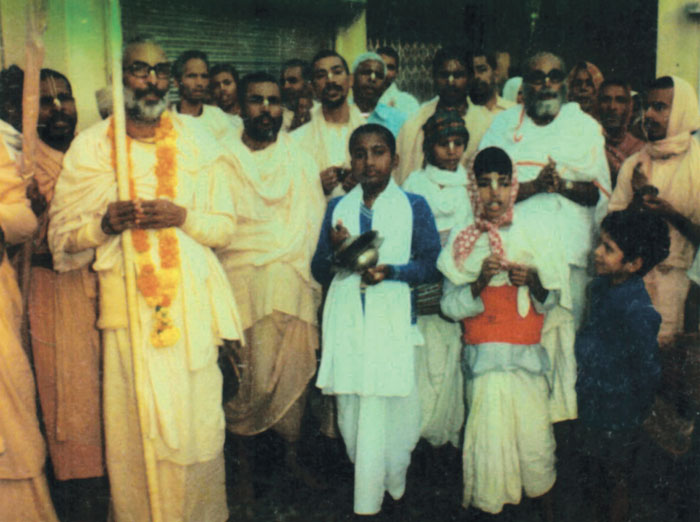
Śrīla Bhaktivedānta Nārāyaṇa Gosvāmī Mahārāja
Establishing the Sārasvata Mission in Mathurā-maṇḍala
To read the previous reports, click on the links: Part 1, Part 2, Part 3.
Fulfilling Śrīla Prabhupāda’s and Śrīla Paramagurudeva’s desire
Śrīla Gurudeva and Śrī Keśavajī Gauḍīya Maṭha
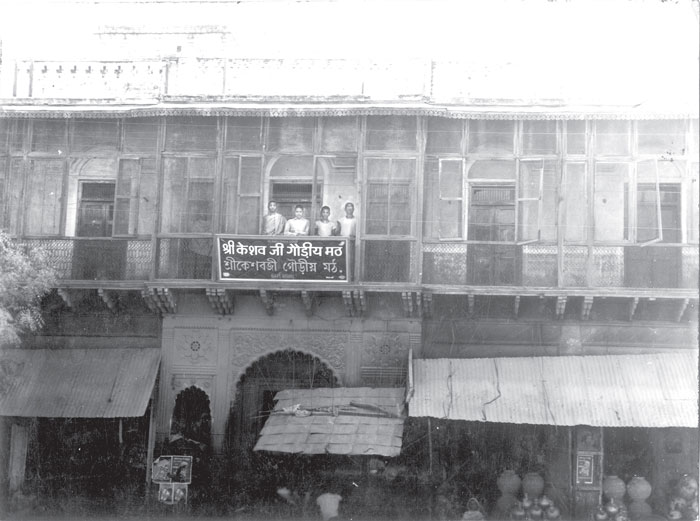
In 1954, nitya-līlā-praviṣṭa oṁ viṣṇupāda aṣṭottara-śata-śrī Śrīla Bhakti Prajñāna Keśava Gosvāmī Mahārāja, an intimate associate of Śrīla Bhaktisiddhānta Sarasvatī Ṭhākura Prabhupāda, acquired a dharmaśālā in Jawahar Haat. It was not far from where Śrīla Prabhupāda had stayed during his 1932 parikramā at Śrī Baladeva Vilāsa Bhavan in Dampier Nagar, Mathurā-dhāma [Refer to Part 2, Page 2]. Paramagurudeva transformed that dharmaśālā into a maṭha, which he named Śrī Keśavajī Gauḍīya Maṭha. He entrusted our most worshipful Śrīla Gurudeva, nitya-līlā-praviṣṭa oṁ viṣṇupāda aṣṭottara-śata-śrī Śrīmad Bhaktivedānta Nārāyaṇa Gosvāmī Mahārāja, with the responsibility of running that maṭha. Furthermore, he assigned to Śrīla Gurudeva the service of preaching Śrīman Mahāprabhu’s message, especially the rūpānuga conceptions, in the Hindi language, throughout Mathurā and Śrī Vraja-maṇḍala. Through such efforts, he laid the foundation for fulfilling Śrīla Prabhupāda’s cherished desires for Śrī Vraja-maṇḍala.
At this very place, our revered Paramagurudeva, Śrīla Bhakti Prajñāna Keśava Gosvāmī Mahārāja, took a firm vow to fulfil the heart’s desire of Śrīla Prabhupāda by opposing the misconduct and deviations in religious practices prevalent in the western and northern regions of India and by propagating the pure bhakti-dharma as preached and practised by Śrīman Mahāprabhu.
Fulfilling the heart’s desire of Śrīla Prabhupāda and Śrīla Paramagurudeva through his practice (ācāra) and preaching (pracāra)
While residing in the sacred land of Śrī Mathurā-dhāma, Śrīla Gurudeva, through his ideal bhajana, impeccable conduct, dynamic preaching, and dedicated service, perfectly imbibed the teachings of his worshipful Śrīla Gurudeva, his Paramagurudeva, and the rūpānuga Gauḍīya ācāryas. Thus by deeply entering these teachings and living them, he served the Gauḍīya sampradāya in an unprecedented way, spreading the conceptions of the rūpānuga line to people across Mathurā-maṇḍala, Northern India, and also throughout the world.
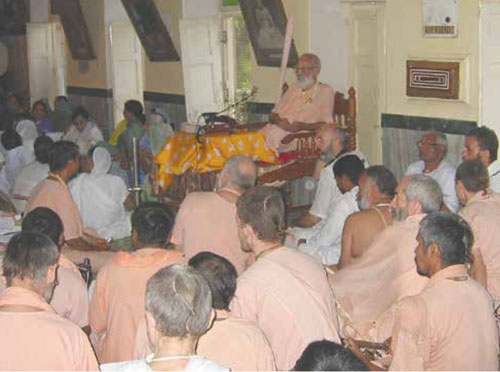 As mentioned in Part 2, page 7, Śrīla Prabhupāda had once expressed grave concerns about the lackings in the Gauḍīya sampradāya’s presentation of the rūpānuga conceptions within Vraja-maṇḍala. By his rigorous practice and preaching, Śrīla Gurudeva gloriously served Śrīla Prabhupāda, thus fulfilling his innermost desires.
Through the following endeavours, he raised an awareness of the glory of the rūpānuga Gauḍīya sampradāya within Mathurā-maṇḍala.
His preaching to the Mathurāvāsīs
Winning the hearts of the Mathurāvāsīs
Faithfully and skillfully, Śrīla Bhaktivedānta Nārāyaṇa Gosvāmī Mahārāja propagated the Gauḍīya conceptions in Mathurā, tirelessly going from door to door, to preach, perform kīrtana and deliver hari-kathā. The Mathurāvāsīs had previously viewed Gauḍīya Vaiṣṇavism as a Bengali religion, one that has no particular relevance to their own mode of worship. By offering heartfelt respect to Mathurā’s scholarly community and to the Vaiṣṇavas of other sampradāyas residing there, as well as showing genuine affection to the local people – men, women, and children – he gradually introduced the Mathurāvāsīs to the rūpānuga line. Through the ever-flowing streams of his extraordinary hari-kathā, he gradually made them aware of the pristine rūpānuga conceptions, and hundreds of Mathurāvāsīs became eager to hear more about the process of rūpānuga-bhajana.
Establishing Gauḍīya Vaiṣṇavism within Mathurā
Śrīla Gurudeva maintained cordial relationships with the Vaiṣṇavas and scholars of other sampradāyas residing in Mathurā and Vraja. He invited such Vaiṣṇavas and scholars to participate in assemblies held in his maṭhas, to discuss the topics of Śrīmad-Bhāgavatam. In these discussions, Śrīla Gurudeva drew the hearers’ attention to the elevated conceptions and practices of the Gauḍīya Vaiṣṇava ācāryas, explaining the erudite and rasika Sanskrit commentaries on Śrīmad-Bhāgavatam, particularly those of Śrīla Jīva Gosvāmī and Śrīla Viśvanātha Cakravartī Ṭhākura. Reliably, he spoke to them about Śrī Kṛṣṇa being born in Gokula and only appearing in Mathurā.
Mostly, these respected Vaiṣṇavas and scholars opine that Kṛṣṇa has a marital relationship with damsels of vraja. Gurudeva revealed to them the pristine purity of parakīya-bhāva (transcendental paramour love) by presenting the evidence from Śrīmad-Bhāgavatam and the above-mentioned commentaries. That the Mathurāvāsī scholars and Vaiṣṇavas from other sampradāyas developed respect for Gauḍīya Vaiṣṇavism gives us an idea of how refined Śrīla Gurudeva’s method was in presenting the rūpānuga conceptions and thus fulfilling Śrīla Prabhupāda Sarasvatī Ṭhākura’s desire for Mathurā-maṇḍala. Gauḍīya Vaiṣṇavism was subsequently held in regard by the spiritually influential Vaiṣṇavas there. Thereafter, rarerly any opposition came from other sampradāyas in Vraja regarding the practice of the rūpānuga conceptions.
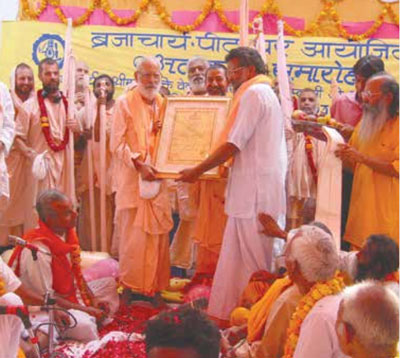 Śrīla Gurudeva’s affection and reverence for the residents of Vraja were evident in his inviting distinguished personalities, scholars, and in fact any resident of Mathurā (Vraja), to Śrī Keśavajī Gauḍīya Maṭha before he left to preach abroad, so as to receive the Vrajavāsīs’ blessings for the propagation of vraja-bhakti. Witnessing Śrīla Gurudeva’s successful overseas preaching, the highly respected residents of Varṣāṇā honoured him with the esteemed title “Yugācārya”.
Accepting the position of ācārya
To stimulate the living entities’ interest in Śrī Caitanya, or Kṛṣṇa consciousness, and to awaken within them sevonmukha-vṛtti (the disposition to serve Śrī Kṛṣṇa), Śrīla Gurudeva, upon the desire and instruction of his senior god-brother Śrīla Bhaktivedānta Vāmana Gosvāmī Mahārāja, compassionately began to give initiation. With great dedication, he served as the parivrājaka-ācārya of Śrī Keśavajī Gauḍīya Maṭha.
He was an affectionate shelter, full of vātsalya (parental affection) for anyone who came under his shield. He thus perfectly fulfilled the role of both a śikṣā-guru, guiding devotees in service to their dīkṣā-guru, and later, himself, as a dīkṣā-guru.
Bṛhat-mṛdaṅga
Presenting our guru-varga via the bṛhat-mṛdaṅga
While residing at Śrī Keśavajī Gauḍīya Maṭha, Śrīla Gurudeva tirelessly spoke on the works of the Six Gosvāmīs and the other Gauḍīya Vaiṣṇava ācāryas, which illuminate the path of pure bhakti for all living beings and which reveal the effulgent love of the vraja-devīs for Kṛṣṇa. Such works are devoid of even the slightest scent of the desires for dharma, artha, kāma, and mokṣa, which are essentially selfish.
Firmly commited to propagating and preserving the rūpānuga sāmpradāyika conceptions, Śrīla Gurudeva fully dedicated himself to the service of the bṛhat-mṛdaṅga (the publishing and propagation of transcendental literature). He was particularly noted for his captivating hari-kathā, which was a nectarean tonic for the listeners’ hearts.
Śrī Bhāgavata Patrikā
It was at Śrī Keśavajī Gauḍīya Maṭha that Śrīla Paramagurudeva initiated the publication of the spiritual Hindi monthly magazine Śrī Bhāgavata Patrikā. He entrusted Śrīla Gurudeva with the responsibility of serving as editor. Because the patrikā’s language was profound and philosophically deep, it quickly gained immense respect among Mathurā’s scholarly community. Many came to appreciate the supremacy of bhakti-dharma in the Gauḍīya Vaiṣṇava tradition and began to praise it highly.
Translating the works of the Gauḍīya ācāryas
Śrīla Paramagurudeva had instructed Śrīla Gurudeva to translate the works of the Gauḍīya ācāryas, especially those of Śrīla Bhaktivinoda Ṭhākura, Śrīla Viśvanātha Cakravartī Ṭhākura, Śrīla Rūpa Gosvāmī, and others, into Hindi.
While residing at Śrī Keśavajī Gauḍīya Maṭha, Śrīla Gurudeva published his Hindi translations of the Gauḍīya mahājanas’ revered works, such as Bhakti-rasāmṛta-sindhu-bindu, Ujjvala-nīlamaṇi, and Bṛhad-bhāgavatāmṛtam. As desired by Śrīla Prabhupāda, He also delivered numerous discourses revealing the confidential topics within Śrī Caitanya-caritāmṛta, such as rūpa-śikṣā, sanātana-śikṣā, rāya-rāmānanda-samvād and Ratha-yātrā.
Sat-kriyā-sāra-dīpikā and Saṁskāra-dīpikā
 While residing at Śrī Keśavajī Gauḍīya Maṭha, Śrīla Gurudeva presented Hindi translations of the Vaiṣṇava-smṛti texts – Sat-kriyā-sāra-dīpikā and Saṁskāra-dīpikā – compiled by Śrīla Sanātana Gosvāmī and Śrīla Gopāla Bhaṭṭa Gosvāmī. Through these translations, he propagated the principles of pure devotional conduct (śuddha-bhakti sadācāra-dharma), as refined and established by Śrīla Rūpa and Sanātana Gosvāmīs, throughout Mathurā-maṇḍala.
Prabandha-pañcakam (Five Essential Essays)
Through works such as Prabandha-pañcakam (Five Essential Essays), Śrīla Gurudeva refuted any philosophy that was in the guise of bhakti and opposing the genuine, conclusive truths of pure devotional service (bhakti-siddhānta). With unwavering determination and indomitable enthusiasm, he safeguarded the principles of Śrīla Bhaktisiddhānta Sarasvatī Prabhupāda’s line (the śrī sārasvata-dhārā) so as to bring about the true welfare of all living beings.
Establishing Gauḍīya siddhānta on the foundation of Vedānta
By the inspiration of his Śrī Guru-pādapadma, Śrīla Gurudeva, while residing at Śrī Keśavajī Gauḍīya Maṭha, Mathurā, published in Hindi the prominent works of Śrīla Vyāsadeva – the foundational texts of Vedānta: Śrīmad-Bhāgavatam (śruti-prasthāna), Śrīmad Bhagavad-gītā (smṛti-prasthāna), and Vedānta-sūtra (nyāya-prasthāna). These editions were accompanied by the commentaries of Gauḍīya Vaiṣṇava ācāryas and some portions were enriched with his own illuminations, in which he faithfully presented the Gauḍīya understanding of Vedāntic truth.
Śrī Keśavajī Gauḍīya Maṭha housed the personal books of the Gauḍīya guru-varga
Śrīla Bhakti Prajñāna Keśava Gosvāmī Mahārāja’s blessings upon Śrīla Gurudeva were such that he bestowed upon him his own personal śāstras. Moreover, upon seeing Śrīla Gurudeva’s deep inclination to study śāstra, some other associates of Śrīla Bhaktisiddhānta Sarasvatī Ṭhākura Prabhupāda blessed him by gifting him with many sacred texts. Śrīla Gurudeva preserved these texts with great reverence, keeping them in the library of his bhajana quarters in Śrī Keśavajī Gauḍīya Maṭha, Mathurā. A significant portion of Śrīla Gurudeva’s time was spent studying and deeply pondering these scriptures. His bhajana-kuṭī in Mathurā was like a grove of scriptures, its many bookshelves housing numerous Bengali and Hindi texts. Fifty years of Bengali Śrī Gauḍīya Patrikās and forty-five years of the Hindi Śrī Bhāgavata Patrikā also graced those shelves. It was amidst this grove of divine words that Śrīla Gurudeva sat, absorbed in bhajana and smaraṇa.
Śrīla Gurudeva had desired that his entire library would be preserved, so each and every book was carefully scanned over a period of years, and in 2021, in honour of his centennial appearance day, this archive was made available in PDF format on purebhakti.com. [LINK] This contribution by Śrīla Gurudeva will benefit sincere seekers both in the present and the future.
Observance of festivals and tithis
Propagating the correct observance of Ekādāśī
Previously, Mathurāvāsīs were mostly observing Ekādaśī in accordance with the smārta calender, which lists Ekādaśī tithis (lunar dates) even if those tithis are impure, meaning mixed with the previous day’s Daśamī tithi during the brahma-muhūrta. It was at Śrī Keśavajī Gauḍīya Maṭha that Śrīla Gurudeva introduced and annually published in Hindi the calendar of Vaiṣṇava observances and festivals (Vaiṣṇava Vratotsava-tālikā), in accordance with Śrī Hari-bhakti-vilāsa, the vaiṣṇava-smṛti (Vaiṣṇava ritual codex) compiled by Śrīla Sanātana Gosvāmī. By so doing, hundreds of people throughout Mathurā-maṇḍala and elsewhere now observe śuddha (pure) Ekādaśī and also other Vaiṣṇava vratas and festivals on the pure tithis, in accordance with the method of calculation given in Śrī Hari-bhakti-vilāsa.
The authentic way of collecting alms
From Śrī Keśavajī Gauḍīya Maṭha, Śrīla Gurudeva would send the brahmacārīs to collect dvādaśī-bhikṣā from the Mathurā residents. In this way, also, he introduced Śrī Keśavajī Gauḍīya Maṭha and the teachings of Śrīman Mahāprabhu to the Mathurāvāsīs. Without discriminating between rich and poor, Śrīla Gurudeva would personally go from house to house with the brahmacārīs to speak kathā and do kīrtana. Sometimes, he would return to the maṭha as late as 11 or 12 at night, and only after returning would he and the brahmacārīs partake of prasāda. Śrīla Gurudeva always prioritized preaching-oriented bhikṣā (meaning alms were received as a by-product of preaching) over bhikṣā-oriented preaching (preaching as a means to collect alms), thereby revealing his pure intention to propagate Mahāprabhu’s message.

Celebrating Vaiṣṇava festivals with depth
Every year, while residing at Śrī Keśavajī Gauḍīya Maṭha, Śrīla Gurudeva would enthusiastically organize various festivals such as Śrī Guru Pūrṇimā, Śrī Baladeva Pūrṇimā, Śrī Janmāṣṭamī, and Śrī Rādhāṣṭamī. The hallmark of his observance of these festivals was his revelation of the profound philosophical truths (tattva-darśana) behind these divine personalities and their pastimes. The grandeur of the festival was always secondary. Every evening, in the week before the festival, Śrīla Gurudeva would have the devotees speak on the tattva expounded by the personality whose festival they were about to observe, such as guru-tattva, baladeva-tattva, kṛṣṇa-tattva, and rādhā-tattva. The devotees under his guidance received the opportunity to be trained by him in Gauḍīya siddhānta and in presenting it, and occasionally they received correction from him. The audience found their talks most illuminiating.
Observance of a grand vyāsa-pūjā on Āṣāḍhī Pūrṇimā tithi, the appearance day of Śrīla Vyāsadeva
Śrīman Mahāprabhu performed vyāsa-pūjā, or guru-pūjā, on the day of Āṣāḍhī Pūrṇimā, the appearance day of Śrīla Vyāsadeva. An account of this is found in Śrī Caitanya-bhāgavata (Madhya-khaṇḍa, Fifth Chapter).
Later, the followers of Śrīla Prabhupada residing in the various Gauḍīya maṭhas would honour the appearance of Śrīla Vyāsadeva on this day as token respect. Conversely, they would observe a grand festival in honour of the appearance day of the founder ācārya of their maṭha. And some would observe, in a grand manner, only the appearance day of the present day ācārya of their institution, understanding him to be a representative of Śrīla Vyāsadeva.
Our Śrīla Gurudeva, Śrīla Bhaktivedānta Nārāyaṇa Gosvāmī Mahārāja, introduced to the Gauḍīya Sārasvata line, on a widespread scale, the observance of vyāsa-pūjā on the Āṣāḍhī Pūrṇimā tithi, the appearance day of Śrīla Vyāsadeva. Notably, he did this at Śrī Keśavajī Gauḍīya Maṭha, Mathurā being the birthplace of Śrī Kṛṣṇa Dvaipāyana Vedavyāsa. As the name Dvaipāyana (he who came on an island) indicates, he was born on an island in the Yamunā near Mathurā.
When the ācāryas of different institutions are worshipped on their appearance days as representatives of Vyāsadeva, only the disciples of that ācārya are likely to be inclined to perform pūjā of their guru. Since there are many gurus in present times and since there will inevitably be more and more gurus in times to come, it will not be possible for any one group to honour them all.
 Moreover, although the disciples observe the vyāsa-pūjā of their guru, who is the representative of Vyāsadeva, on their guru’s appearance day, that observance may or may not be true vyāsa-pūjā unless their guru offers the pūjā he receives from them (his disciples) to his own guru, guru-paramparā, and Śrīla Vyāsadeva.
But Śrīla Gurudeva, by honouring and observing vyāsa-pūjā on Āṣāḍhī Pūrṇimā tithi, the appearance day of the original Vyāsa (Śrīla Vyāsadeva), worshipped the whole guru-paramparā, or the undivided guru-tattva, thus resolving any quandary that may arise in this regard.
Śrīla Gurudeva wrote a few articles on the glories of Śrīla Vyāsadeva, the significance of śrī vyāsa-pūjā, and the absolute neccessity of peforming vyāsa-pūjā in order to make one’s human birth successful. These articles were published in Śrī Bhāgavata Patrikā. Śrīla Vyāsadeva’s literary contributions are numerous, and all of humanity is indebted to him for his Śrīmad-Bhāgavatam, Upaniṣads, Śrīmad Bhagavad-gītā, Vedānta-sūtra, Mahābharata, and so forth.
In Mathurā and elsewhere in India, all the Vaiṣṇava sampradāyas, including the Śāṅkara sampradāya, and also common people, observe Āṣāḍhī Pūrṇimā tithi, the appearance day of Śrīla Vyāsadeva. From the perspective of thoroughly understanding and following the philosophical conclusions of Śrīla Vyāsadeva, it is debatable how genuine the said worship is. According to Śaṅkara, Śrīla Vyāsadeva was mistaken. So, how much honour do Śaṅkara’s followers truly have for Śrīla Vyāsadeva? It is therefore imperative for the Gauḍīya ācāryas, who are the genuine representatives of Śrīla Vyāsadeva, to step forward and honour this blessed tithi, following the mood exhibited by Śrīla Prabhupāda Bhaktisiddhānta Sarasvatī Ṭhākura, who personally demonstrated devotion to the worship of Śrīla Vyāsadeva and the practice of vyāsa-pūjā. On the occasion of his own appearance, however, Śrīla Prabhupāda spoke the following words, thus demonstrating the mood of one who sits on the āsana of Vyāsa:
Śrīmad Ānanda Tīrtha [Śrīman Madhvācārya], while engaged in the worship of Śrī Vyāsa […] to demonstrate the proper ideal of such worship, ascended the vyāsāsana (seat of Vyāsa) and performed the duties of an ācārya […] for eighty years. In the line of his followers, it remains a sign of fidelity to him to sit upon the vyāsāsana according to [disciplic] succession and explain the meaning of the Śrīmad Bhāgavatam.
From a worldly point of view, reflecting on one’s own disqualification might become an obstacle to ascending the vyāsāsana. Yet may we never, under the sway of the sinful tendency to disobey the divine command of our śrī gurudeva, become estranged from the service of the lotus feet of our guru – this alone is our humble submission at the feet of both Śrī Vyāsadeva and Śrīman Madhvācārya. …
In regard to my personal identity and position, I know myself to be unqualified, not even fit to be spoken to, forever a servant of the followers of Śrī Rūpa. Therefore, this present disorderliness (viśṛṅkhalatā) is but a symptom of my inherent unworthiness (ayogyatā-nibandhan).
If the assembled listeners kindly forgive my audacity, I may become eligible to serve them in the role of a servant. But if my voice is stifled, I shall be denied the right to participate in śrī vyāsa-pūjā.
For this reason, I humbly submit this earnest plea before you all: Just as you have bestowed the privilege of performing vyāsa-pūjā upon countless great personalities, please grant me too that right, if only for a fleeting moment.
(From the weekly Gauḍīya, 6th Khaṇḍa, February 25, 1928 Issues 28–29)
Furthermore, as expressed in Śrīla Prabhupāda’s speech above, as true representatives of Śrīla Vyāsadeva (vyāsānuga), it is the duty of the Gauḍīya ācāryas to honour the Āṣāḍhī Pūrṇimā tithi, the appearance day of Śrīla Vyāsadeva, the original Vyāsa, and accept the worship of the common people in order to connect them to a bona fide line of worship and lead them to their supreme auspiciousness. If Gauḍīya ācāryas do not step up to this task, the common people are bound to offer their worship to those who are not bona fide representatives of Śrīla Vyāsadeva and remain deprived of their eternal welfare.
Śrī Rūpa Gosvāmī Conference and Jhūlana-yātrā
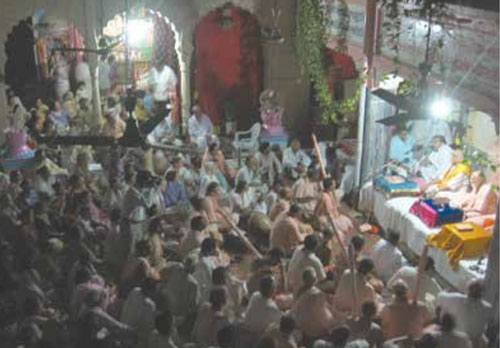 Every year, between Śrī Śrī Rādhā-Govinda’s Jhūlana-yātrā and Śrī Baladeva Pūrṇimā, Śrīla Gurudeva held a three-day conference at Śrī Rūpa-Sanātana Gauḍīya Maṭha, Vṛndāvana, to commemorate the disappearance of Śrīla Rūpa Gosvāmī and to keep Śrīla Rūpa Gosvāmī’s profound contribution alive in the Gauḍīya line. The assembly consisted of Vaiṣṇavas and learned scholars from throughout Vraja. Through this annual conference, Vraja-maṇḍala and the whole world gradually became aware of the tenets of Gauḍīya rūpānuga-rasa-upāsanā.
On this occasion, in his talk concluding the festival, after other speakers had expressed their reflections, Śrīla Gurudeva would highlight the unparalleled glories, teachings, and contributions of Śrīla Rūpa Gosvāmī, as well as unveil the mysteries of Jhūlana-yātrā. His talk was enriched by his descriptions of the traditions and songs of Vraja (vraja-rīti), the songs of exalted Vaiṣṇavas (paramahaṁsa-gīti), and principles involved in relishing rasa (rasika-nīti) in the swing festival.
Śrī Kṛṣṇa Janmāṣṭamī & Śrī Rādhāṣṭamī
In 1932, when Śrīla Prabhupāda resided in Mathurā during the month of Kārtika, he organized a grand kṛṣṇa-nāma-saṅkīrtana in Mathurā city for the welfare of all. Years later, on the day prior to Śrī Kṛṣṇa Janmāṣṭamī, Śrīla Gurudeva engaged his dedicated sevakas in organizing an annual grand śobhā-yātrā (chariot procession) from Śrī Keśavajī Gauḍīya Maṭha. It was accompanied by tumultuous nāma-saṅkīrtana, which resounded throughout the ancient city. Riding on the last chariot of the parade, Śrīla Gurudeva showered affectionate blessings on the masses of onlookers. This festival is observed by his sevakas to this day.
In the days leading up to Janmāṣṭamī, Śrīla Gurudeva would speak elaborately on kṛṣṇa-tattva. Importantly, he explained that Vrajendra-nandana Kṛṣṇa was born from the womb of Mother Yaśodā in Gokula and four armed Devakī-nandana Kṛṣṇa appeared before Vasudeva and Devakī in the prison in Mathurā. It is Vrajendra-nandana Śrī Kṛṣṇa who is worshipped by the Gauḍīyas and whose birth is celebrated by them on Janmāṣṭamī. The next day, they observe Nandotsava.
On the occasion of Śrī Rādhāṣṭamī, again Śrīla Gurudeva spoke on rādhā-tattva for several days leading up to the festival. He introduced Vraja’s unique tradition of chāva (bringing a heartfelt offering that expresses one’s inner joy). Hundreds of devotees went in different saṅkīrtana parties to the homes of various Mathurāvāsīs, who had prepared hundreds of baskets of various offerings for Śrīmatī Rādhārāṇī. When the parties reached the maṭha, Śrīla Gurudeva personally greeted them. By this, the hearts of the Mathurāvāsīs and participants from all over the world were filled with the festive spirit of Vraja culture.

Guiding the world into Śrī Vraja-dhāma & Śrī Navadvīpa dhāma
As a faithful follower of the sārasvata-dhārā, Śrīla Gurudeva unfailingly led and organized the annual Śrī Vraja-maṇḍala and Śrī Navadvīpa-dhāma parikramās, which were eagerly attended by devotees from all over India and across the globe. In order to both glorify and guide others through the sacred pastime places (līlā-sthalīs), he carried forward this cherished tradition with unwavering dedication.
Śrī Vraja-maṇḍala parikramā
For fifty years in the month of Kārtika, Śrīla Gurudeva organized the annual Śrī Vraja-maṇḍala parikramā from Śrī Keśavajī Gauḍīya Maṭha. Following in the footsteps of Śrīman Mahāprabhu, he would lead hundreds of devotees from India and abroad in making a saṅkalpa (vow) at Viśrāma-tīrtha (ghāṭa) for their successful execution of the parikramā. He would then circumambulate Vraja-maṇḍala and the pastime places marked by the footprints of Śrīman Mahāprabhu, in accordance with the mood in the kīrtana Śuddha-bhakata: gaura āmāra, ĵe saba sthāne, karalo bhramaṇa raṅge / se-saba sthāna, heribo āmi, praṇayi-bhakata-saṅge – In the company of praṇayi-bhaktas, I will go to all those places that Gaurāṅga joyfully visited.
Śrīla Gurudeva inspired the devotees to organize and perform sincere parikramā of Śrī Girirāja, as well as a grand Annakūṭa-mahotsava and a magnificent mahā-abhiṣeka.
By publishing Śrī Vraja-maṇḍala Parikramā in Hindi, Śrīla Gurudeva made the significance of many of Vraja’s previously unknown līlā-sthalīs easily accessible to all. This book was translated into English.
Additionally, he undertook the task of restoring various līlā-sthalīs of Vraja, such as Bhāṇḍīravata, Jāvaṭa, Uddhava-kyārī (Viśākhā-kuṇḍa), Durvāsā Ṛṣi Āśrama, Kāliya-daha, and Brahma-kuṇḍa.
Śrīla Gurudeva consistently supported Śrī Rāmeśa Bābā of Varṣāṇā’s campaign to protect the līlā-sthalīs of Kāmyavana from land mafia. He personally met with Śrī Rāmeśa Bābā to offer assistance to this noble cause.


Śrī Navadvīpa-dhāma parikramā
In general, the residents of Mathurā were unaware that Śrī Caitanya Mahāprabhu is Śrī Kṛṣṇa Himself adorned with the mood and complexion of Śrī Rādhā and that He appeared in this world to bestow unnata-ujjvala-rasa sva-bhakti śriyam – the mood of Her maidservants. His gift for the jīvas of this world was to show them that entrance into kṛṣṇa-līlā in a mood of amour could only take place through gaura-līlā, and that to enter that amorous kṛṣṇa-līlā, it is essential to understand the topmost purity of parakīya-rasa.
By giving Mathurāvāsīs as well as the faithful souls from across the globe the opportunity to participate in Śrī Navadvīpa-dhāma parikramā, Śrīla Gurudeva expertly acquainted them with gaura-nāma (the holy name of Gaura), gaura-dhāma (the abode of Gaura), and gaura-kāma (the divine desires of Gaura) and thus informed them of the unique contributions, glories, and teachings of Śrīman Mahāprabhu.
Service to Śrīla Prabhupāda’s associates and to their disciples
Exemplifying kṛṣṇa-anuśīlana through kārṣṇa-anuśīlana
From time to time, Śrīla Bhakti Prajñāna Keśava Gosvāmī Mahārāja came to Śrī Keśavajī Gauḍīya Maṭha, and Śrīla Gurudeva with the affection of a perfect disciple, attentively heard the hari-kathā, specifically vraja-kathā, emanating from his Gurudeva’s lotus mouth and observed his ideal conduct and practice of bhajana. And whenever Śrīla Prabhupāda’s numerous intimate associates such as Śrīla Bhaktivedānta Svāmī Mahārāja, Śrīla Bhakti Pramoda Purī Gosvāmī Mahārāja, Śrīla Bhakti Sarvasva Giri Gosvāmī Mahārāja, Śrīla Bhakti Prapanna Dāmodara Gosvāmī Mahārāja, Śrīla Bhakti Bhūdeva Śrautī Gosvāmī Mahārāja, Śrīla Bhakti Jīvana Janārdana Gosvāmī Mahārāja, Śrīla Bhakti Vaibhava Purī Gosvāmī Mahārāja, Śrīla Kṛṣṇa dāsa Bābājī Mahārāja, and others visited Mathurā-maṇḍala, they would come to Śrī Keśavajī Gauḍīya Maṭha and reside there for some days. Śrīla Gurudeva, by the mercy of his Śrīla Gurudeva, was fortunate to attain the association of such exalted Vaiṣṇavas devotees, and practised kṛṣṇa-bhakti (krṣṇa-anuśīlana) by taking shelter of such dear devotees of Śrī Kṛṣṇa (kārṣṇa-anuśīlana).
The following statement by Śrīla Prabhupāda appeared in Part 2 of the above article:
To engage in kṛṣṇa-anuśīlana, it is essential to first engage in kārṣṇa-anuśīlana (the practice of following in the footsteps of the devotees of Kṛṣṇa). Without kārṣṇa-anuśīlana, kṛṣṇa-anuśīlana is not possible. Only when kṛṣṇa-anuśīlana and kārṣṇa-anuśīlana is performed with a favourable attitude does it produce the fruit of prema. A competitive attitude towards kārṣṇa (the devotees of Kṛṣṇa), seeing them with a mundane mindset as ordinary humans is not kṛṣṇa-anuśīlana.
Śrīla Gurudeva performed kārṣṇa-anuśīlana in an unparalleled way, lovingly serving those exalted Gauḍīya Vaiṣṇavas in the Sārasvata line and engaging in profound philosophical discussions with them. In this way, by serving his beloved Gurudeva and all of those god-brothers of his Gurudeva, he realized many deep and supremely esoteric rūpānuga conceptions, and by embracing those moods and performing kīrtana of them, he exemplifed kṛṣṇa-anuśīlana in his sādhaka form (sādhaka-rūpa).
Receiving such extraordinary mercy and guidance, he immersed himself in narrations of Śrī Kṛṣṇa’s rāgātmikā associates, especially the vraja-devīs, relishing and following their sweet service moods. He thus exemplified internal kṛṣṇa-anuśīlana (the limb of smaraṇa) through kārṣṇa-anuśīlana (following in the footsteps of an eternal resident of Vraja) in one’s internal, self-realized form (siddha-rūpa). This is reflected in the following verse:
-
-
-
-
- ◦sevā sādhaka-rūpeṇa
-
- iddha-rūpeṇa cātra hi
-
- ◦tad-bhāva-lipsunā kāryā
- raja-lokānusārataḥ
-
-
-
Bhakti-rasāmṛta-sindhu (1.2.295)
One who has intense longing to attain rāgātmikā-bhakti follows in the footsteps of the rāgātmikā Vrajavāsīs [such as Śrī Rūpa Mañjarī]. With his external body (sādhaka-rūpa), he should chant and hear according to the practice of rāgānuga-bhakti [as exhibited by Śrīla Rūpa Gosvāmī] and simultanously in his self-realized form (siddha-rūpa) bestowed upon him by his guru, he should perform service in the anugatya of eternal residents of Vraja [or rāgātmikā Vrajavāsīs such as Śrī Rūpa Mañjarī].
His service to Śrīla Bhaktivedānta Svāmī Mahārāja
Śrīla Gurudeva was a lifelong well-wisher, prominent supporter, and distinguished guardian of the worldwide preaching mission of Śrīla Bhaktivedānta Svāmī Mahārāja.
Honoring the desire and request of his śikṣā-guru, Śrīla Bhaktivedānta Svāmī Mahārāja, Śrīla Gurudeva accepted the service of presiding over and personally performing his samādhi ceremony at Śrī Kṛṣṇa-Balarāma Mandira, the ISKCON temple in Vṛndāvana.
 In about 1955, Śrīla Bhaktivedānta Svāmī Mahārāja entrusted his large golden, neem deity of Śrīman Mahāprabhu to his dear god-brother, Śrīla Bhakti Prajñāna Keśava Gosvāmī Mahārāja. This deity has been worshipped at Śrī Keśavajī Gauḍīya Maṭha in Mathurā under the guidance of Śrīla Bhaktivedānta Nārāyaṇa Gosvāmī Mahārāja since that time.
Śrīla Bhaktivedānta Svāmī Mahārāja’s final instruction to Śrīla Gurudeva was to give guidance to his disciples. [Click LINK to listen.] Śrīla Gurudeva took that instruction to heart and endeavoured to nurture and guide them. In this way, he fulfilled the desires of his śikṣā-guru to the best of his ability, demonstrating his dedication to the guru-paramparā.
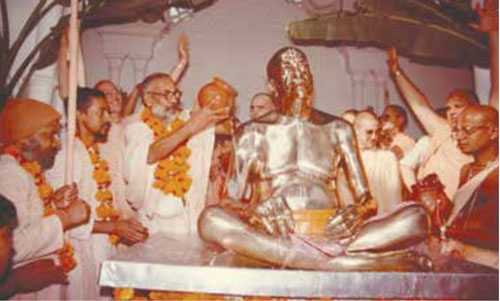 After Śrīla Bhaktivedānta Svāmī Mahārāja entered nitya-līlā, family members from his previous household life made wrongful attempts to take control of the institution he had established, the International Society for Krishna Consciousness (ISKCON), and claimed all its assets. During this critical period, Śrīla Gurudeva journeyed to Mumbai several times, being requested by ISKCON’s Governing Body Commission, to testify in court that he was witnesss to the ceremony in which Śrīla Bhaktivedānta Svāmī Mahārāja formally accepted sannyāsa. Furthermore, he, as the priest, had performed that ceremony, chanting the required mantras and performing the yajña. As a result, ISKCON was protected from an unjust transfer of authority.
In the early 1990s, some GBC members and senior ISKCON devotees regularly visited Śrīla Gurudeva at Śrī Keśavajī Gauḍīya Maṭha to study Gauḍīya scriptures under his guidance. Śrīla Gurudeva generously gave his time to personally acquainting them with some of the profound concepts contained within Brahma-saṁhitā, Jaiva-dharma, Mādhurya-kādambinī, Śrī Rāsa-pañcādhyāyī, Vilāpa-kusumāñjali and other Gauḍīya scriptures.
All Sārasvata Vaiṣṇavas were his family
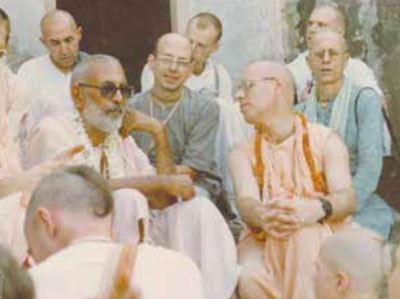 From this very Śrī Keśavajī Gauḍīya Maṭha, Śrīla Bhaktivedānta Nārāyaṇa Gosvāmī Mahārāja extended a token of his gratitude to his śikṣā-guru Śrīmad Bhakti Sarvasva Giri Gosvāmī Mahārāja for his heartfelt support of our Paramagurudeva’s preaching endeavours. [Refer to Part 3, page 10.] Śrīla Gurudeva sent his brahmacārīs to Śrī Vinoda-vāṇī Gauḍīya Maṭha, situated in Śrī Vṛndāvana-dhāma, and had them construct a boundary wall overnight to protect the land of Śrī Vinoda-vāṇī Gauḍīya Maṭha from land mafia. He later boldly proclaimed that they should not think that Vinoda-vāṇī Gauḍīya Maṭha is a single unit that stands alone, but that all Gauḍīya Maṭhas are one.
Even though Śrī Keśavajī Gauḍīya Maṭha was small, devotees from various maṭhas and organizations would reside there under the guidance of Śrīla Gurudeva to be trained in Gauḍīya siddhānta, sevā and bhajana. Being free from feelings of “this is my disciple” and “that is your disicple”, Śrīla Gurudeva, would spiritually nurture everyone equally, as if they were his family members.

Establishing Maṭhas
Establishing maṭhas as centres of kṛṣṇa-anuśīlana
While residing at Śrī Keśavajī Gauḍīya Maṭha, Śrīla Gurudeva oversaw the construction of several prominent maṭhas. He supervised the construction of Śrī Rūpa-Sanātana Gauḍīya Maṭha and Śrī Gopīnātha Bhavan in Vṛndāvana, Śrī Durvāsā Ṛṣi Āśrama in Mathurā, Śrī Giridhārī Gauḍīya Maṭha in Govardhana, Śrī Śrī Keśavajī Gauḍīya Maṭha in Navadvīpa, Śrī Vāmana Gosvāmī Gauḍīya Maṭha in Kolkata, Śrī Ramaṇa-vihārī Gauḍīya Maṭha in Delhi, Jaya Śrī Dāmodara Gauḍīya Maṭha in Purī, and others. The purpose of his doing so was to fulfil the cherished desires of his Śrī Guru-pādapadma and Śrīla Prabhupāda. He established these Gauḍīya Maṭhas so that all could engage in kṛṣṇa-anuśīlana.

Śrī Rūpa-Sanātana Gauḍīya Maṭha, Vṛndāvana
Śrīla Gurudeva established Śrī Rūpa-Sanātana Gauḍīya Maṭha in Sevā-kuñja, Śrīdhāma Vṛndāvana, to preserve, practice, and propagate the Gauḍīya rūpānuga-rasa-upāsanā, devotional absorption steeped in transcendental rasa as taught by Śrīla Rūpa and Śrīla Sanātana Gosvāmīs.

Above the main altar, he established another altar displaying paintings of a Sevā-kuñja pastime that reveals the pinnacle of Gauḍīya conceptions. Śrīla Gurudeva inspired a style of art that is not only uniquely beautiful but cent per cent loyal to Gauḍīya siddhānta. He had several reasons for wanting this scene depicted. He orchestrated and displayed detailed and uniquely beautiful life size paintings of a Seva-kuñja pastime that had manifested in his heart. These paintings are a spiritual window that give aspirants of rūpānuga-rasa-upāsanā a glimpse of that pastime.
[To be continued and concluded in Part 5]
All glories to Śrī Mathurā-dhāma!
All glories to Śrī Keśavajī Gauḍīya Maṭha!
All glories to the Gauḍīya-rūpānuga-sārasvata Guru Paramparā!
All glories to nitya-līlā- praviṣṭa oṁ viṣṇupāda aṣṭottara-śata-śrī
Śrīmad Bhaktisiddhānta Sarasvatī Ṭhākura Prabhupāda!
All glories to nitya-līlā- praviṣṭa oṁ viṣṇupāda aṣṭottara-śata-śrī
Śrīmad Bhakti Prajñāna Keśava Gosvāmī Mahārāja!
All glories to nitya-līlā- praviṣṭa oṁ viṣṇupāda aṣṭottara-śata-śrī
Śrīmad Bhaktivedānta Nārāyaṇa Gosvāmī Mahārāja!
All glories to their dedicated servants!
Gaura premānande!
Translated from Śrī Śrī Bhāgavata Patrikā, Year-20 Issue 5-12
by the Rays of The Harmonist team